Investigation into Factors and Volumes
An investigation into how many cuboids can be made from a number of cubes, linking factor structure and volume.
Investigation into Factors and Volumes
by Nathan Day (@nathanday.bsky.social)
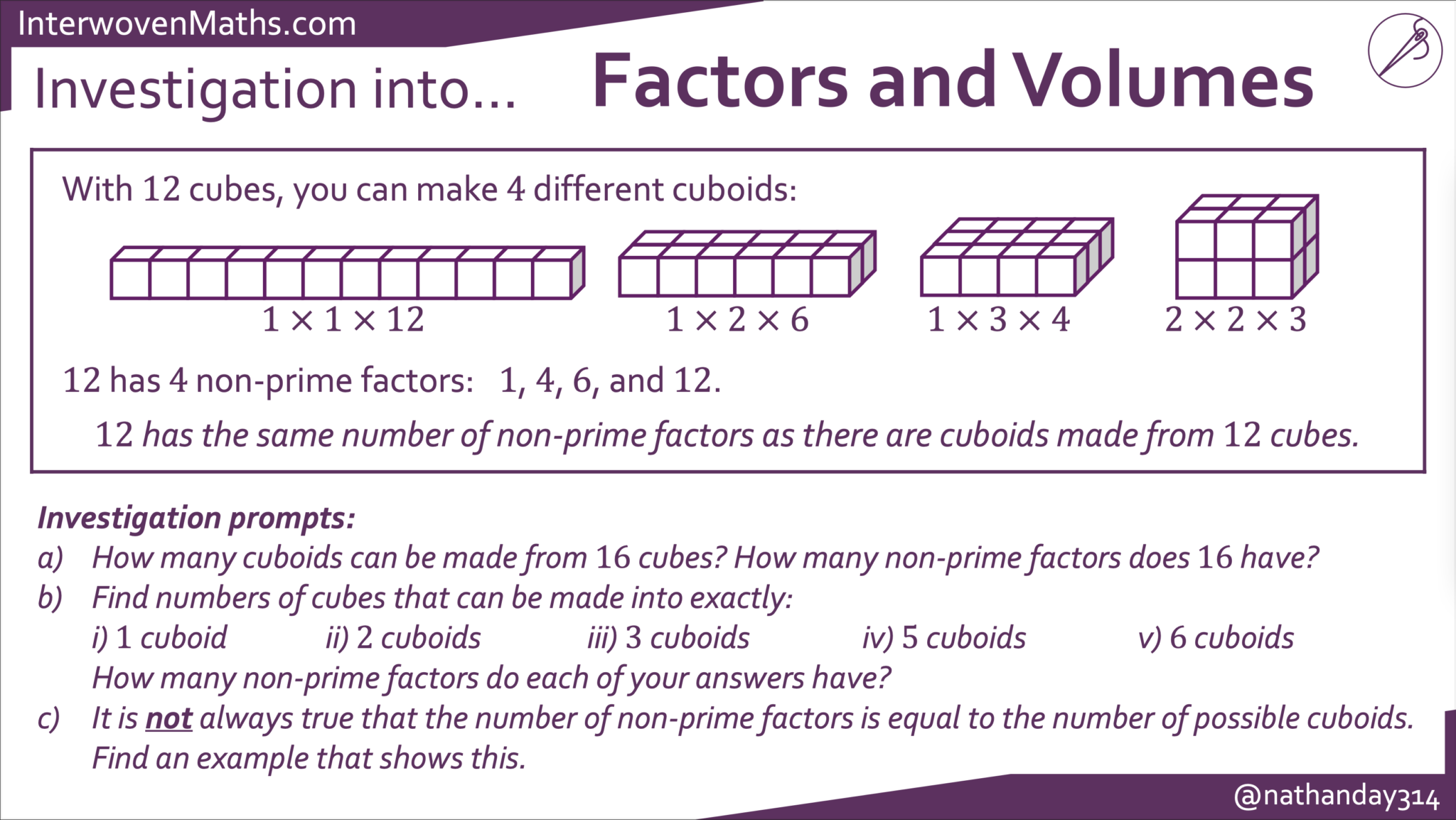
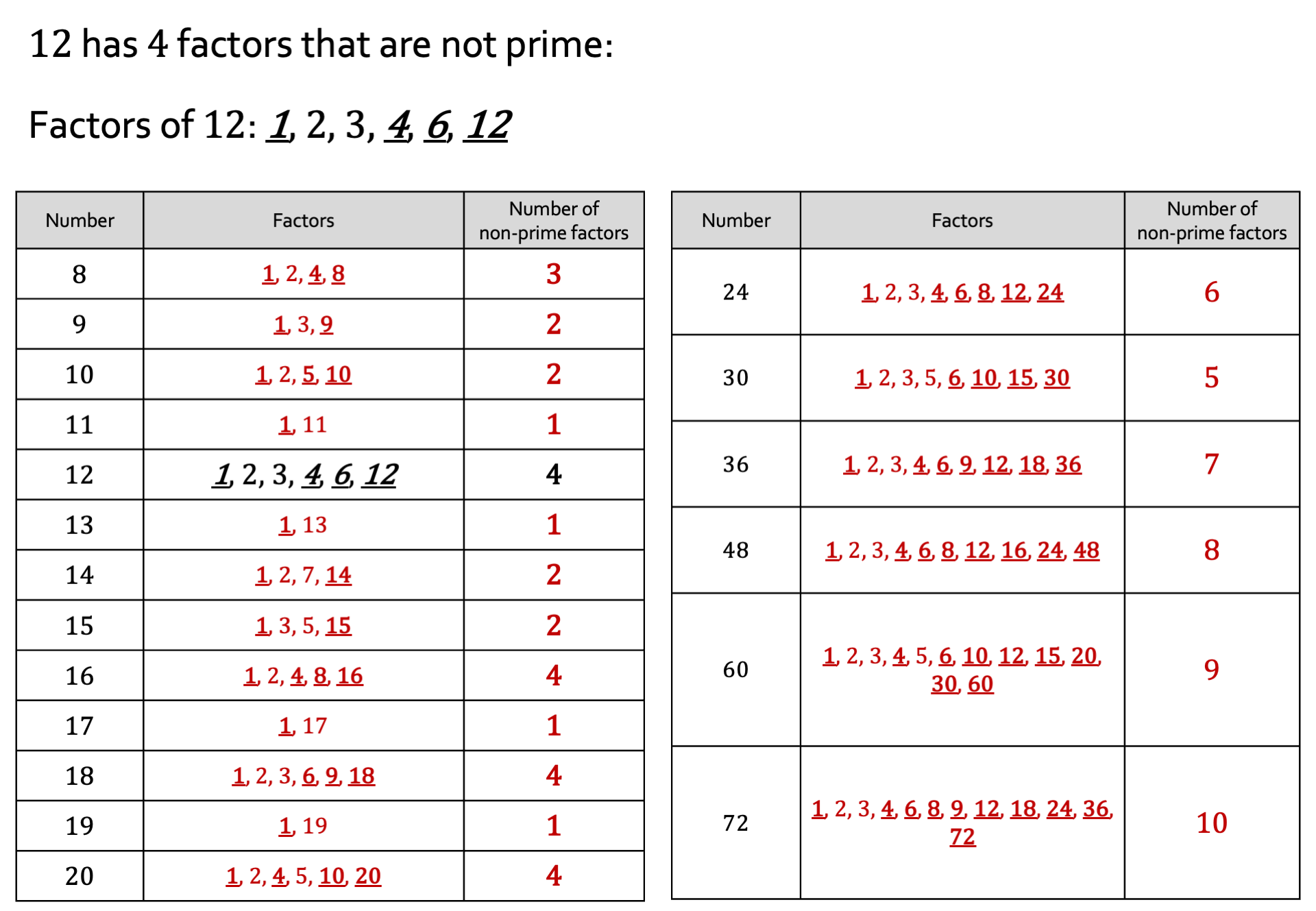
In today’s Year 8 lesson I discovered a startling fact: the number of cuboids you can make from 𝑛 cubes is equal to the number of non-prime factors of 𝑛.
Not long later, I discovered an even startlinger fact: this isn’t true. At least, not for all 𝑛.
I decided this would make for an interesting investigation, interweaving ideas about volume, factors, primes and systematic counting.
I would suggest starting with the questions:
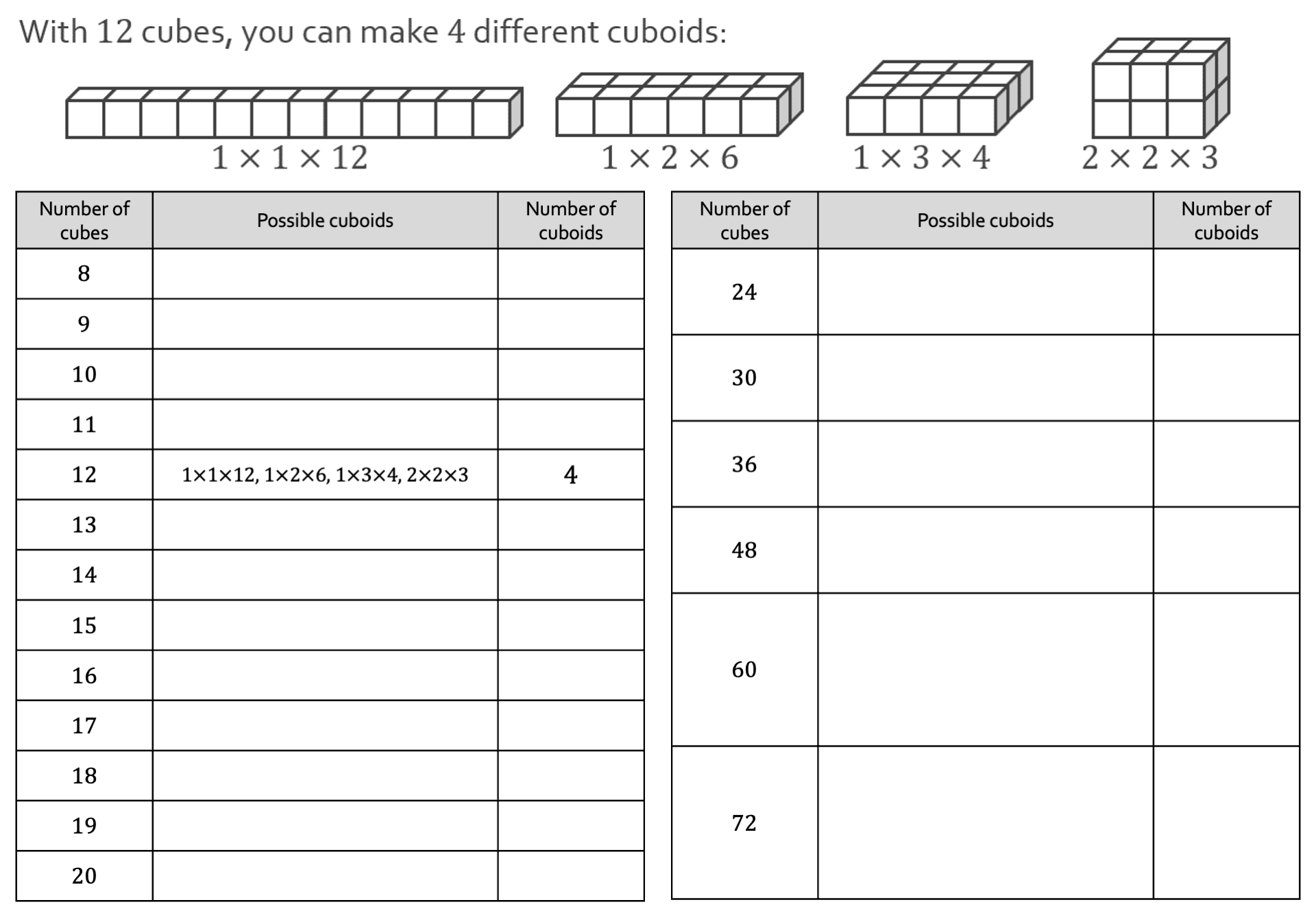
- How many cuboids can be made with 12 cubes? (Not counting rotations.)
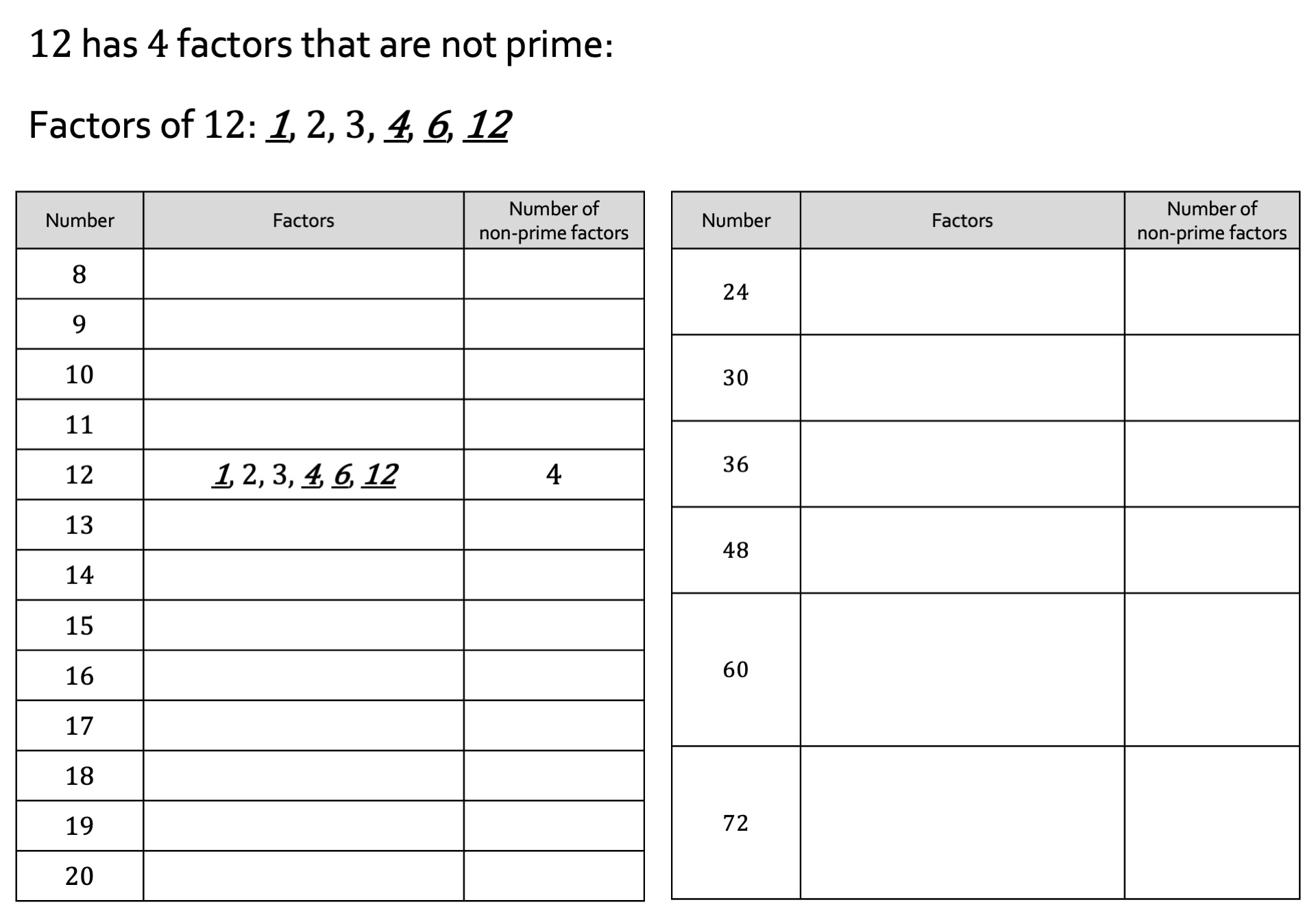
- How many factors of 12 are not prime? (Remembering that 1 is not prime.)
Pupils can then find the same two properties of different numbers, at first aimlessly, later with the goal of finding numbers that give 1 cuboid, 2 cuboids, 3 cuboids etc.
Pupils will find that the two quantities are always equal (unless they are unlucky with their choices), and will be able to generalise to some nice results, e.g.
- Prime numbers always give 1 cuboid and 1 non-prime factor,
- The product of two primes (distinct or non-distinct) always gives 2 cuboids and 2 non-prime factors,
- $$2^𝑛$$ seems to give 𝑛 cuboids and 𝑛 non-prime factors,
- The structure of the prime factorisation is all that matters, for example 12 and 45 will give the same number of cuboids/non-prime factors as they are both the square of a prime multiplied by a different prime.
However, the two quantities are not always equal! [Spoilers below images.]
Below is my summary of the two key properties, and some prompts for guiding the investigation.
This can be given as much or as little structure as you feel appropriate.
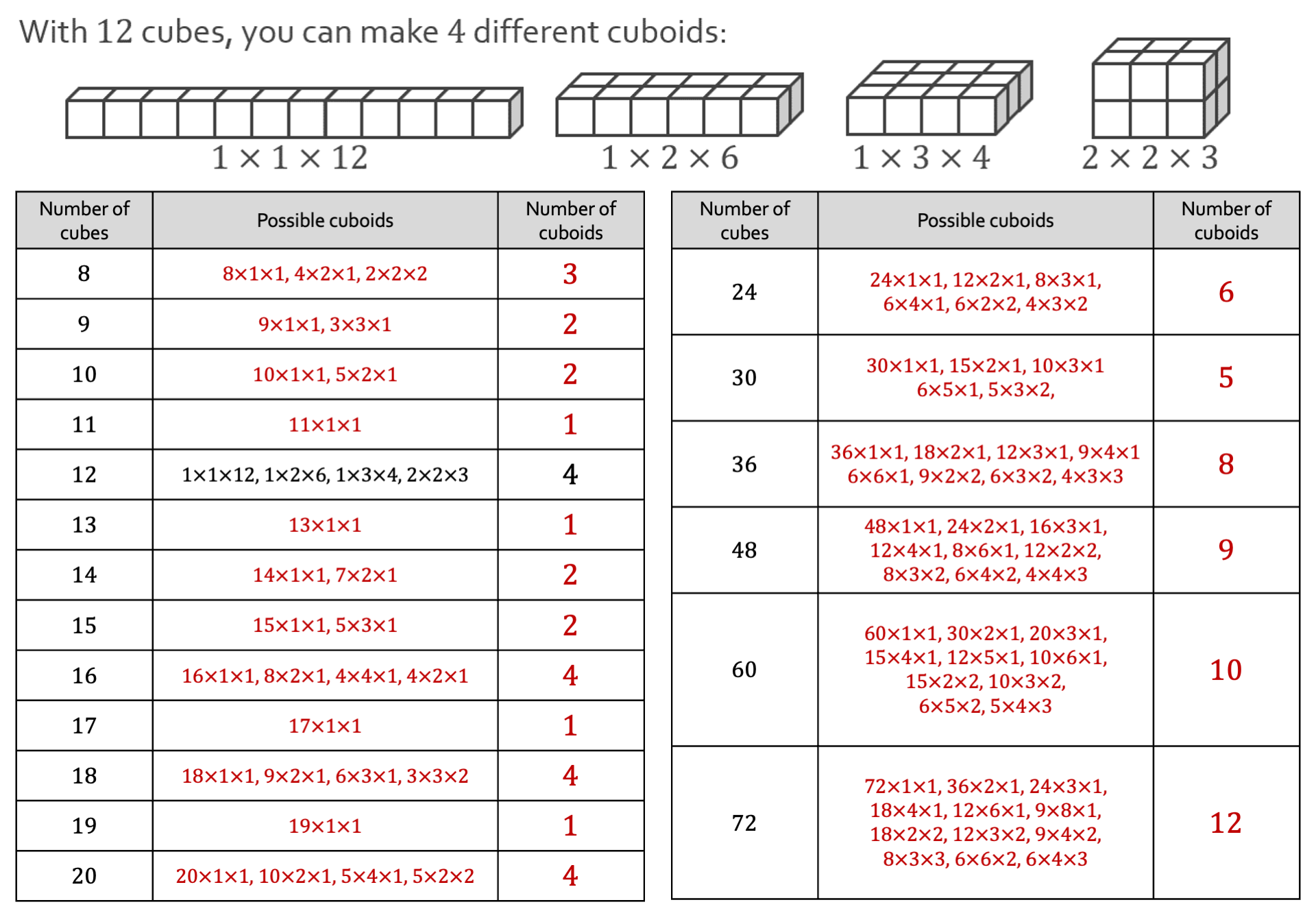
[They aren’t equal for 𝑛 = 36, 48, 60, 64,..]


