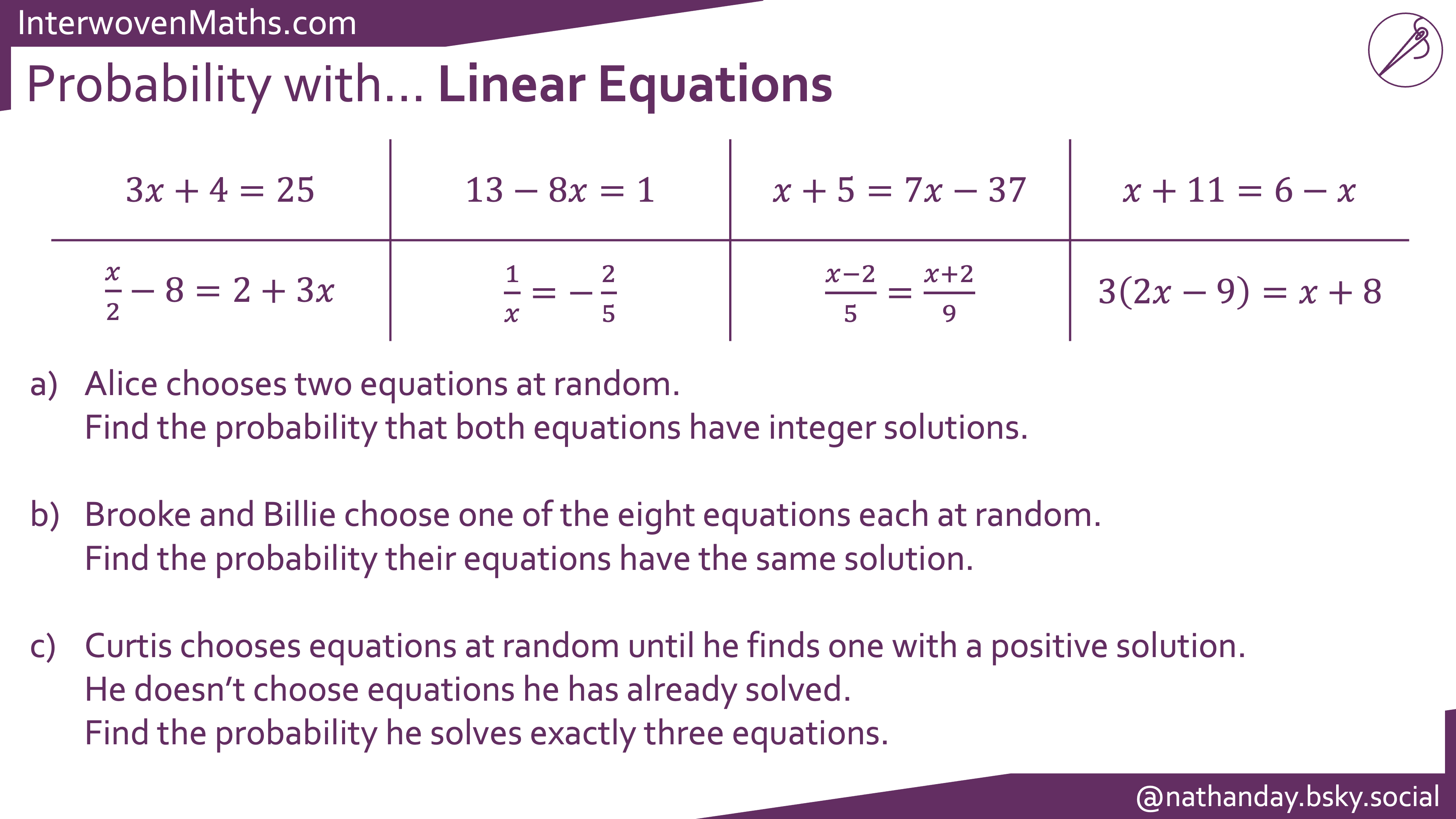
 Interwoven ProbabilitiesProbability questions built around randomly selecting equations, trigonometry problems, vectors and factor-counting cases.
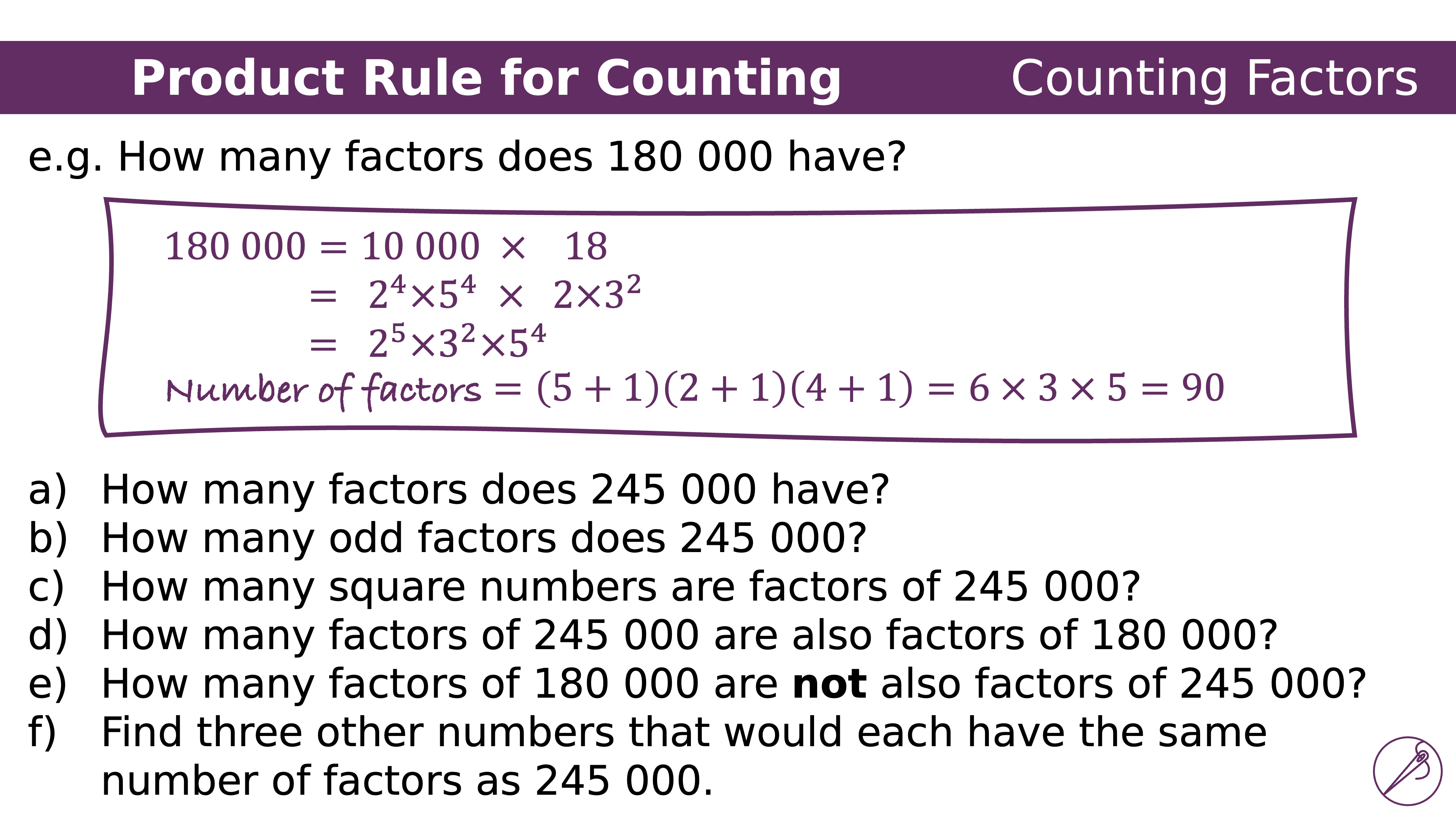 Product Rule for Counting FactorsProduct rule for counting factors task covering prime factorisation, odd and even factors, square factors and common factors.
 Introducing Geometric SeriesAn A Level introduction to geometric series through interwoven tasks on infinite sums, algebra, integration and exponentials.
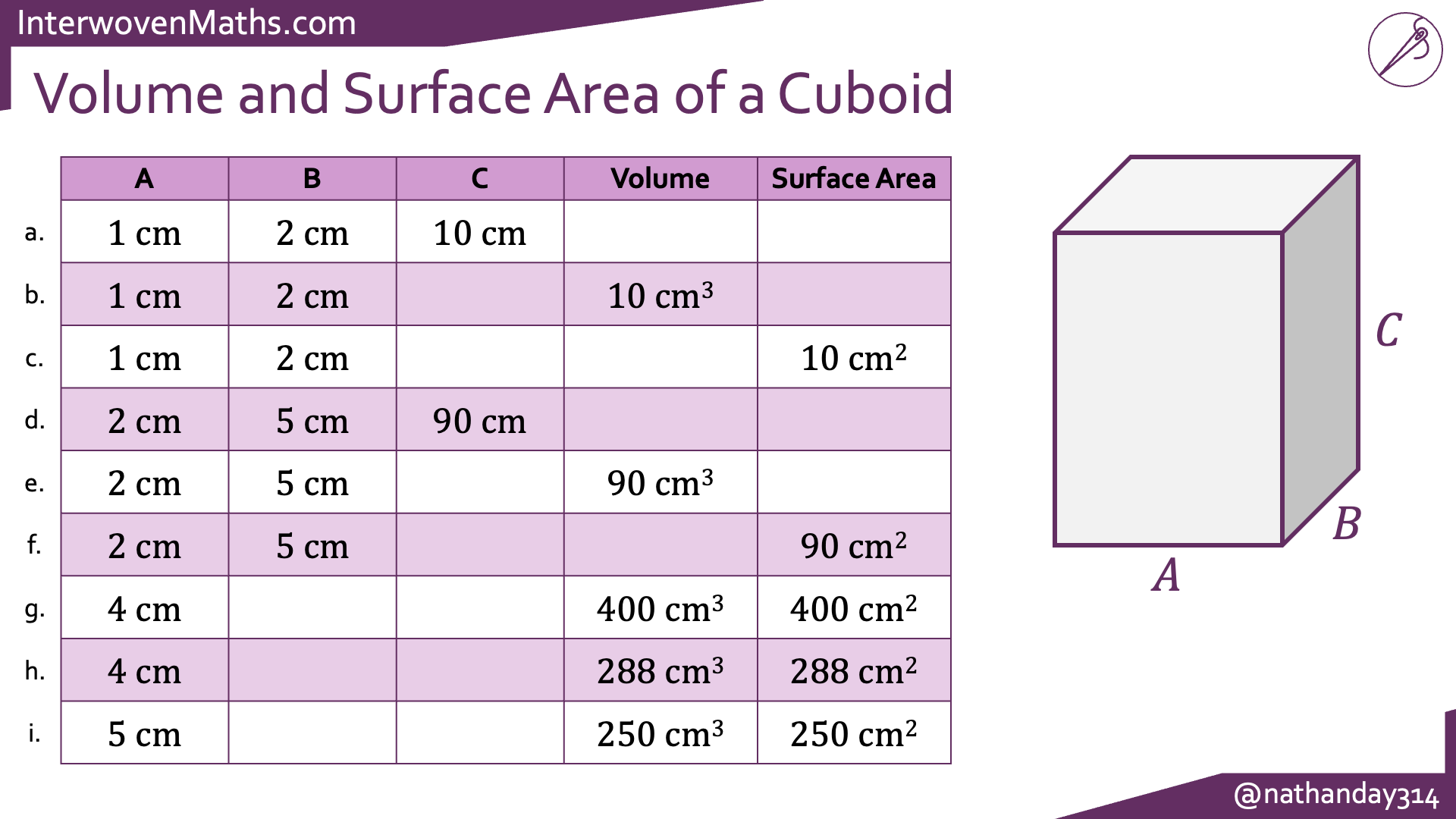 Interwoven Volume and Surface Area Completion TablesVolume and surface area completion tables for cuboids, using missing dimensions, fractions and standard form-style structure.
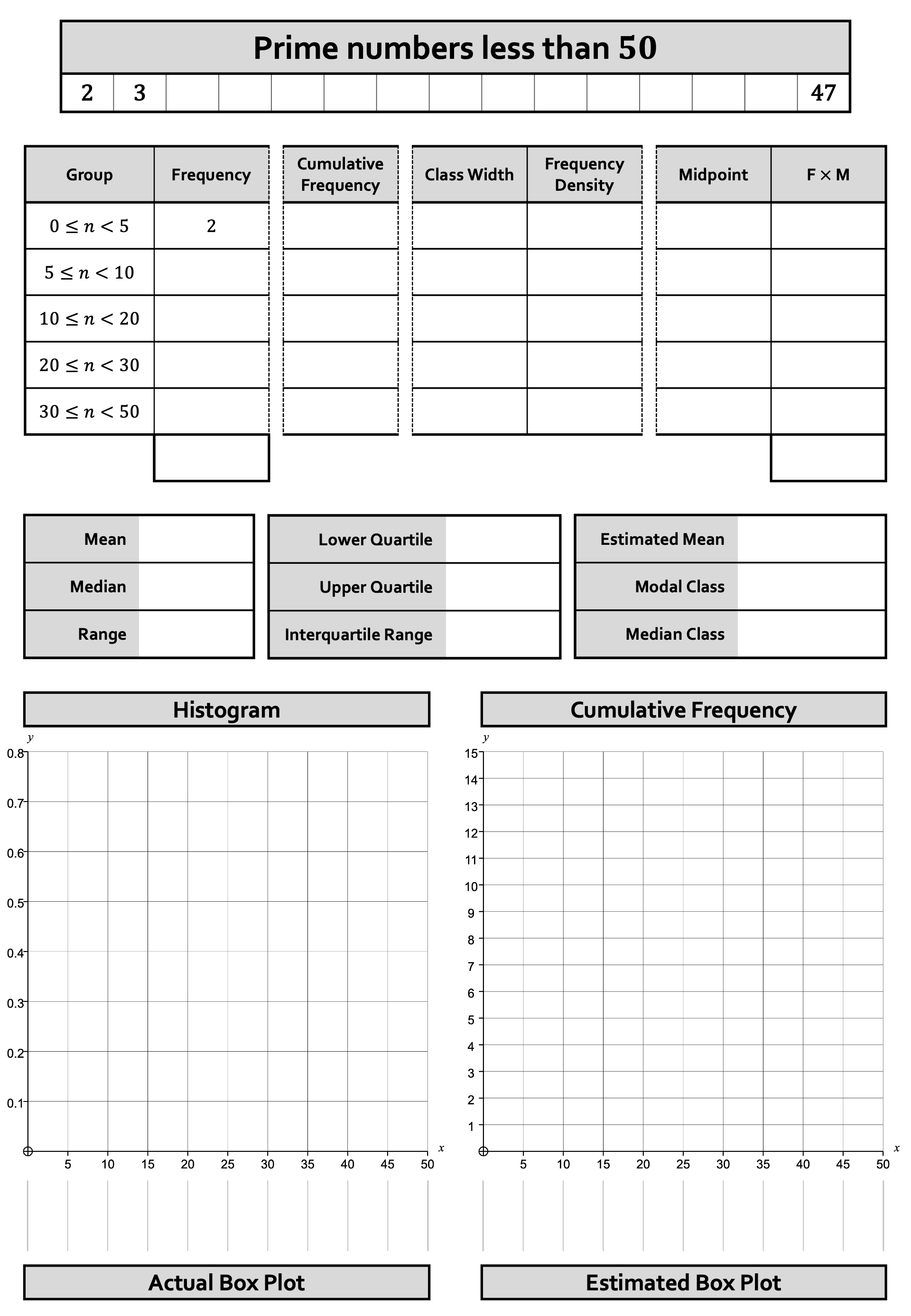 Histograms and Cumulative FrequencyData-handling task linking grouped data, histograms, cumulative frequency, estimated statistics and box plots.
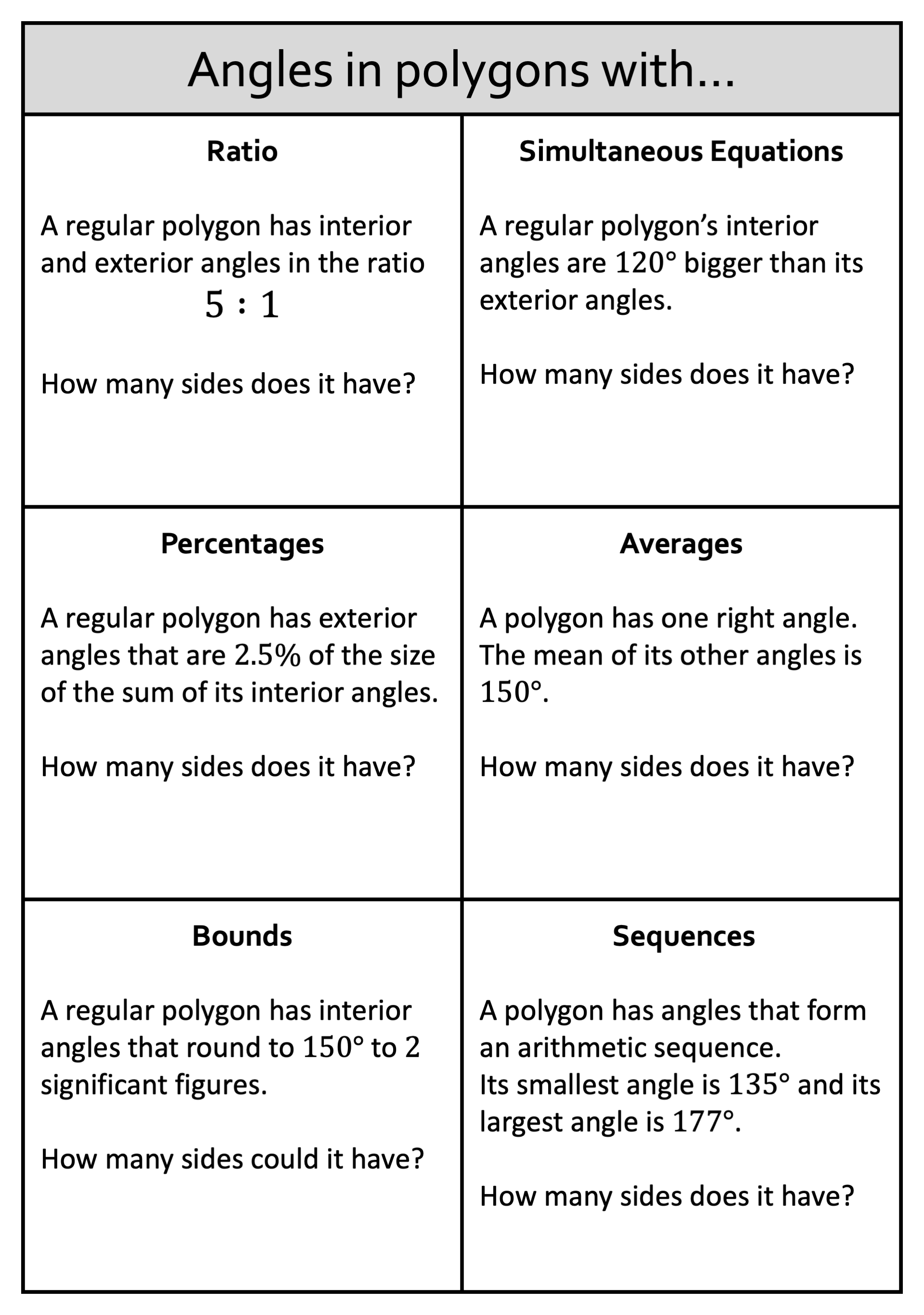 Angles in Polygons with... (Mixed Questions)Mixed angles in polygons questions interwoven with ratio, simultaneous equations, percentages, averages, bounds and sequences.
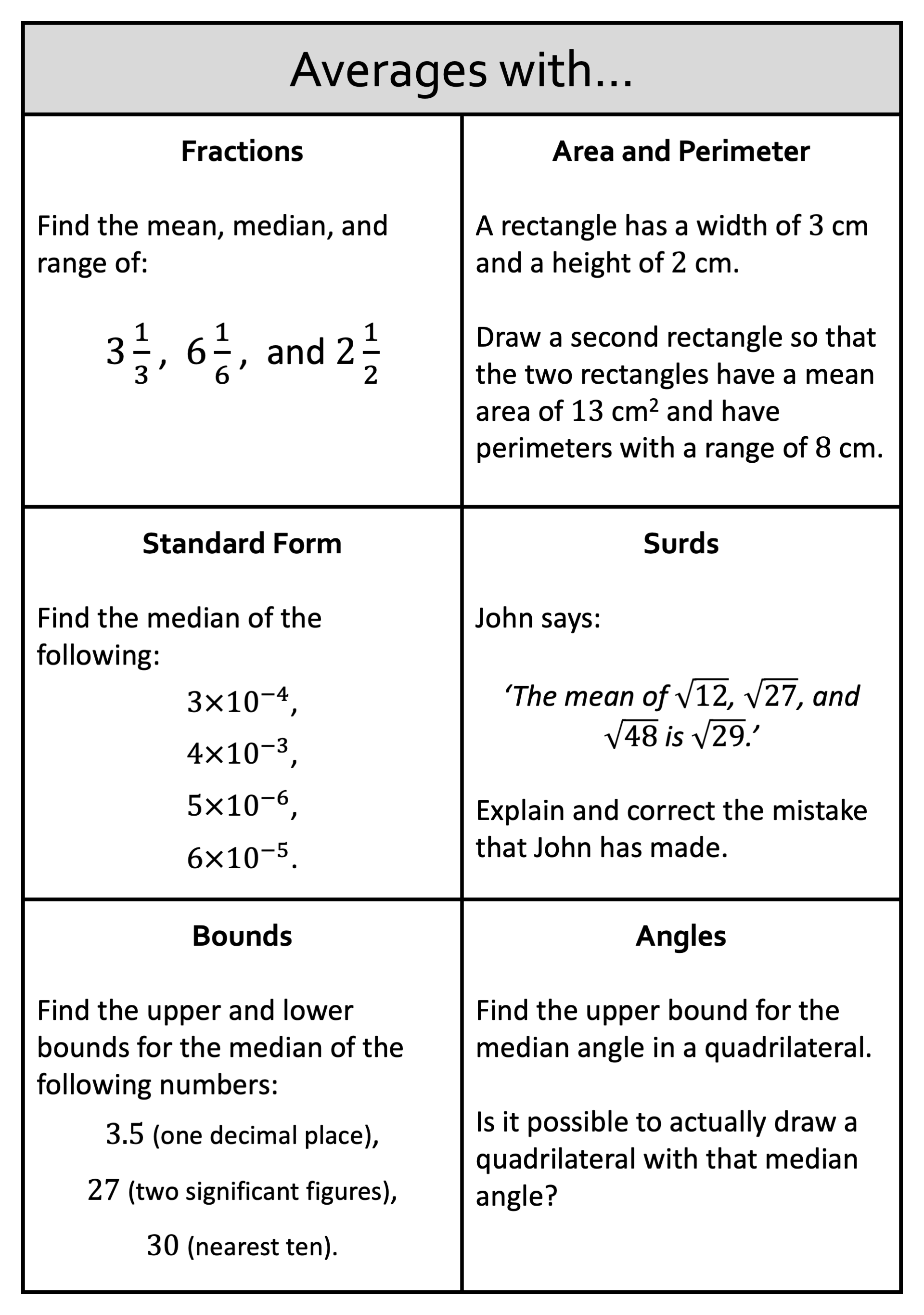 Averages with... (Mixed Questions)Mixed averages questions interwoven with fractions, area, perimeter, standard form, surds, bounds and angles.
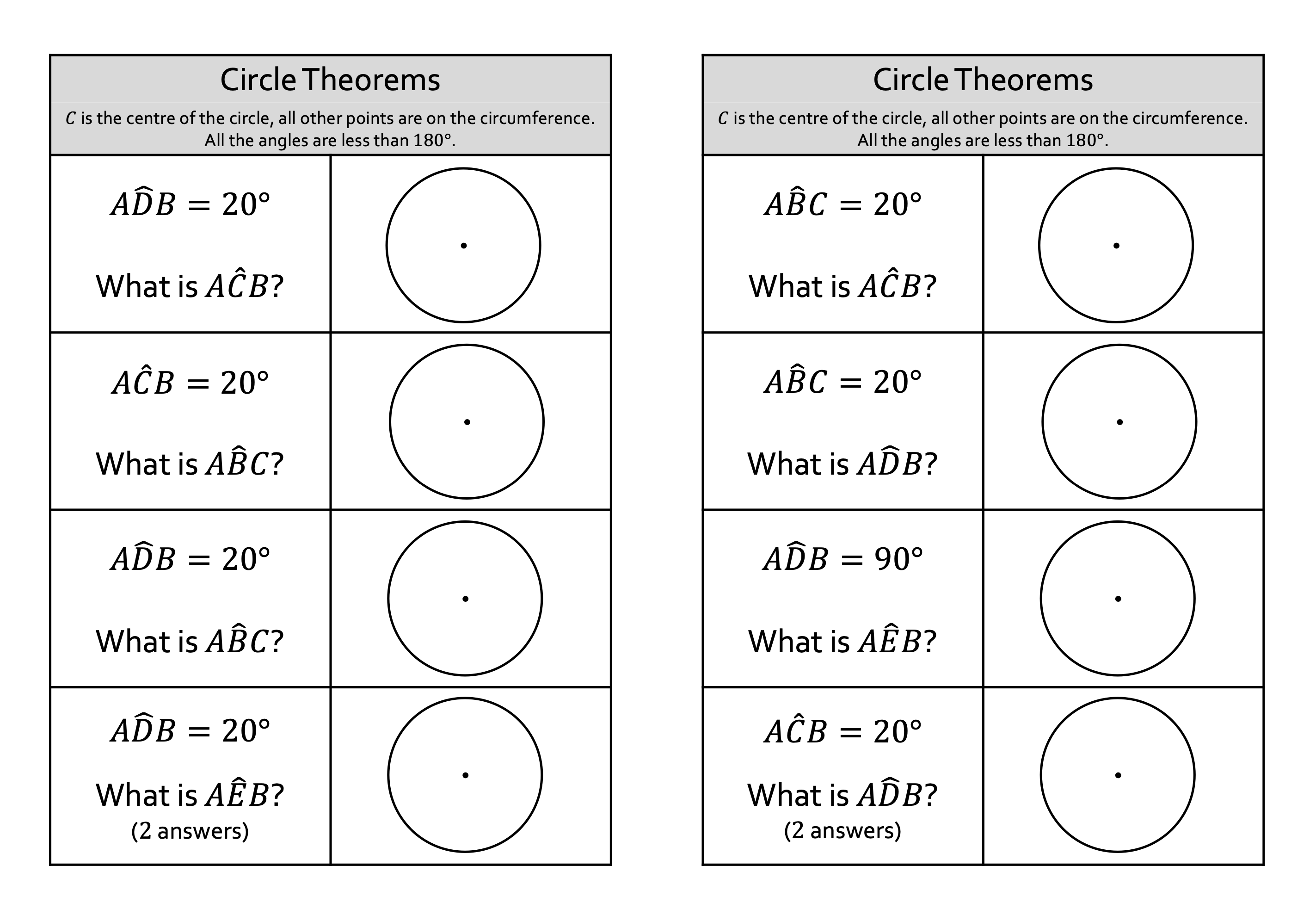 Circle Theorems with... (no diagrams!)A circle theorems reasoning task that removes diagrams so learners must visualise, sketch and justify missing angles.
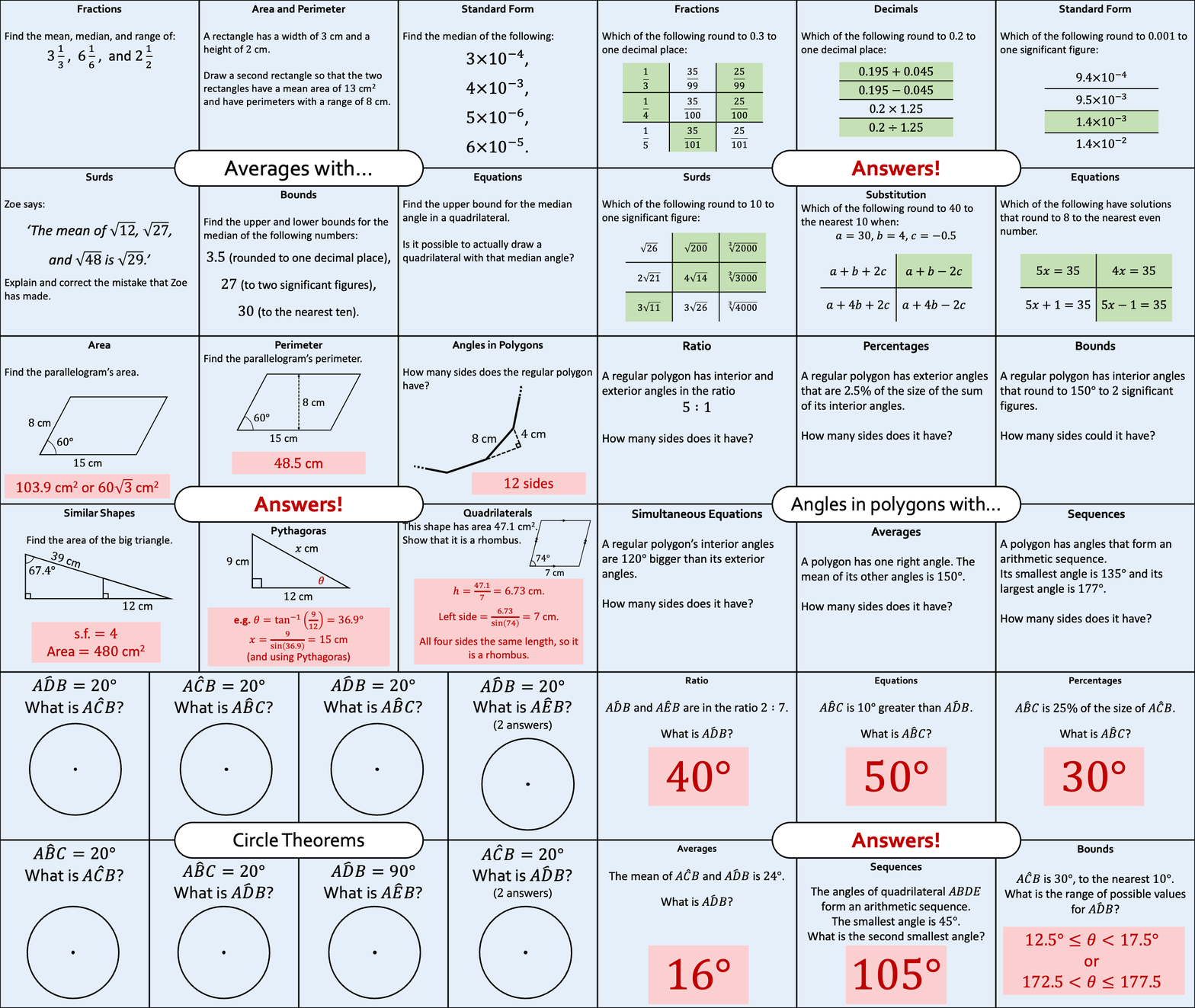 Interwoven Revision Questions to ProjectMixed interwoven revision questions for projecting or printing, covering averages, rounding, trigonometry, Pythagoras and more.
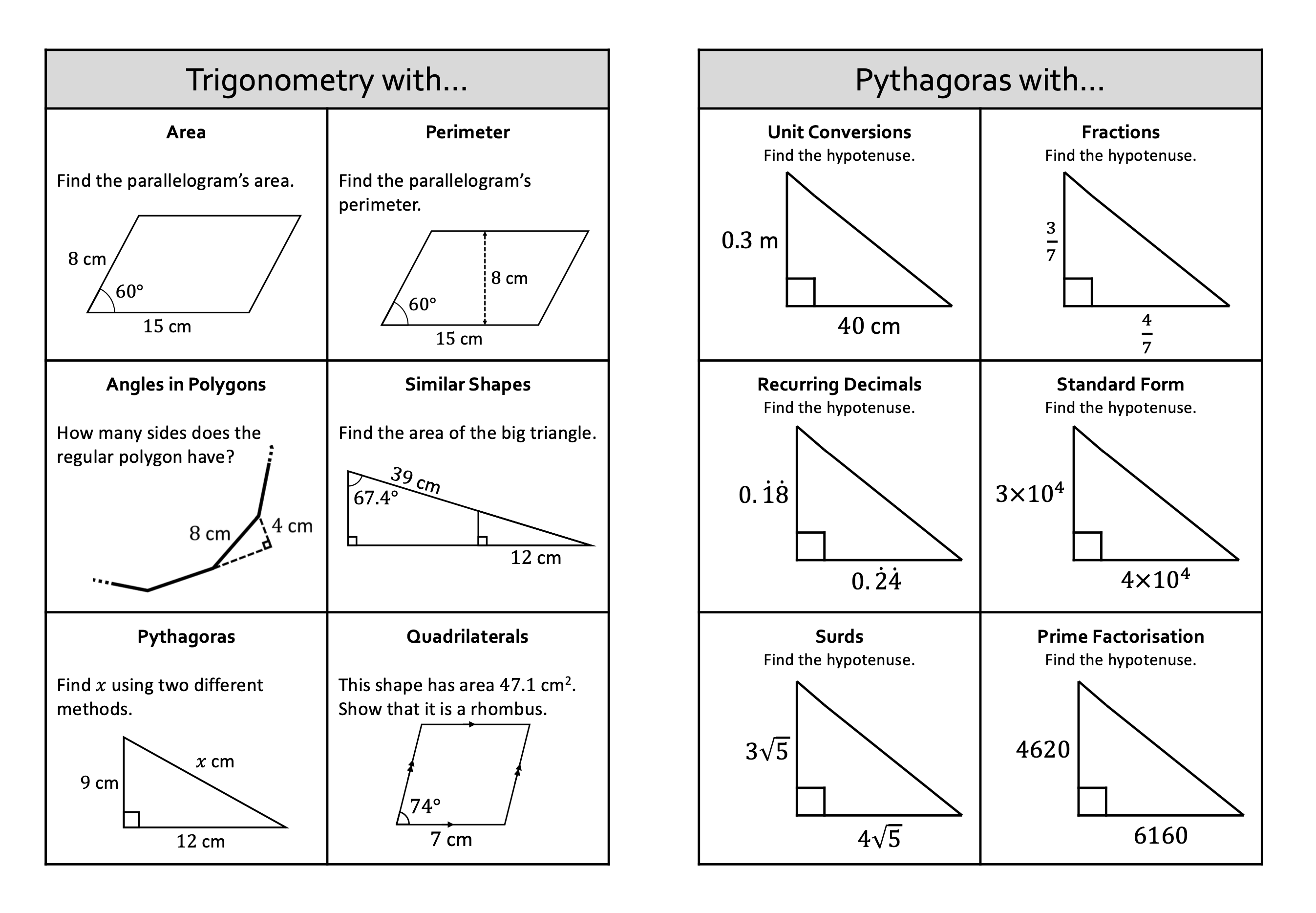 Pythagoras and Trigonometry with... (Mixed Questions)Mixed Pythagoras and trigonometry questions interwoven with unit conversion, fractions, recurring decimals, standard form, surds and prime factorisation.
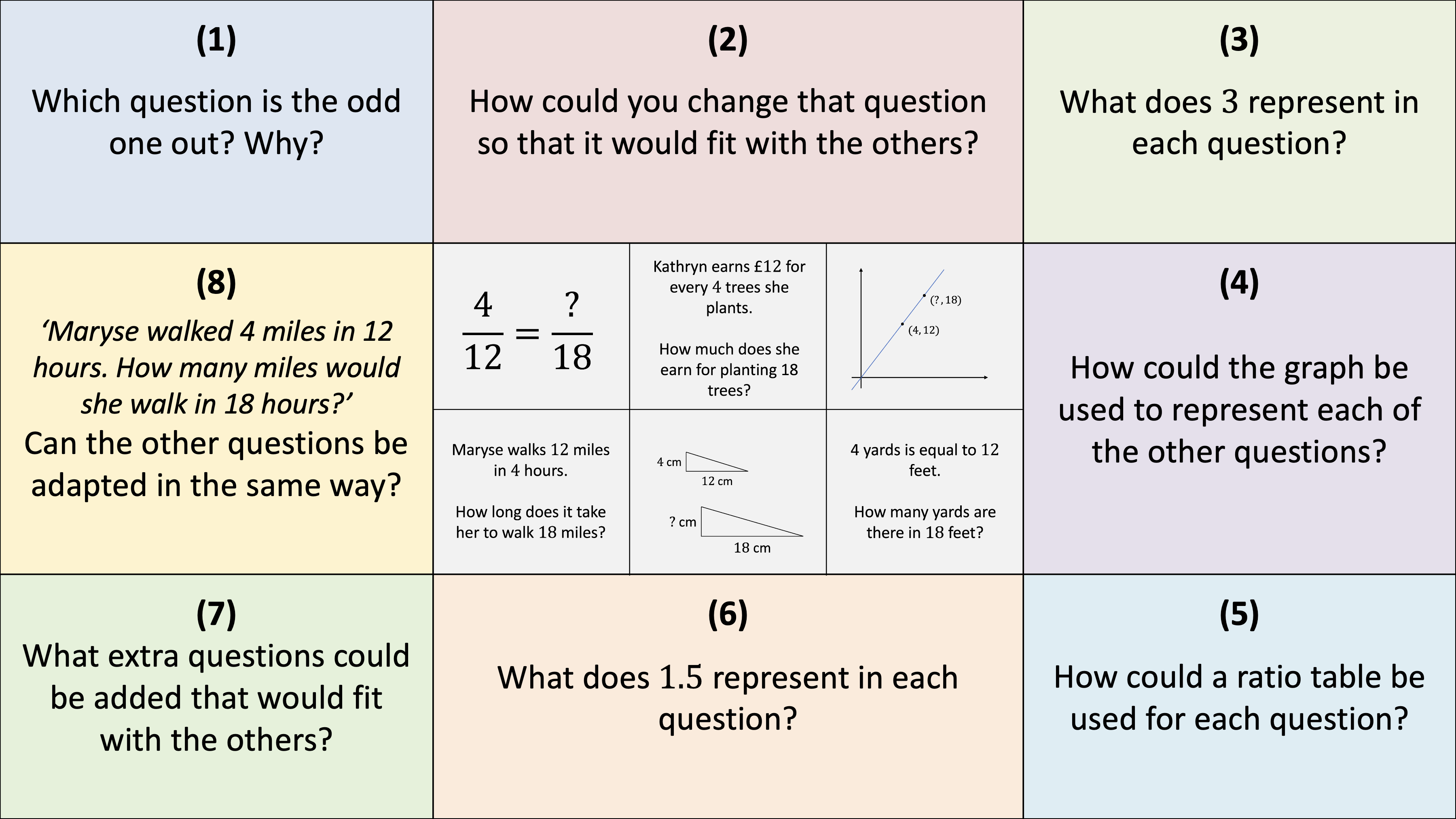 Interwoven ProportionA proportion task connecting ratio tables, graphs and equivalent multiplicative relationships across different contexts.
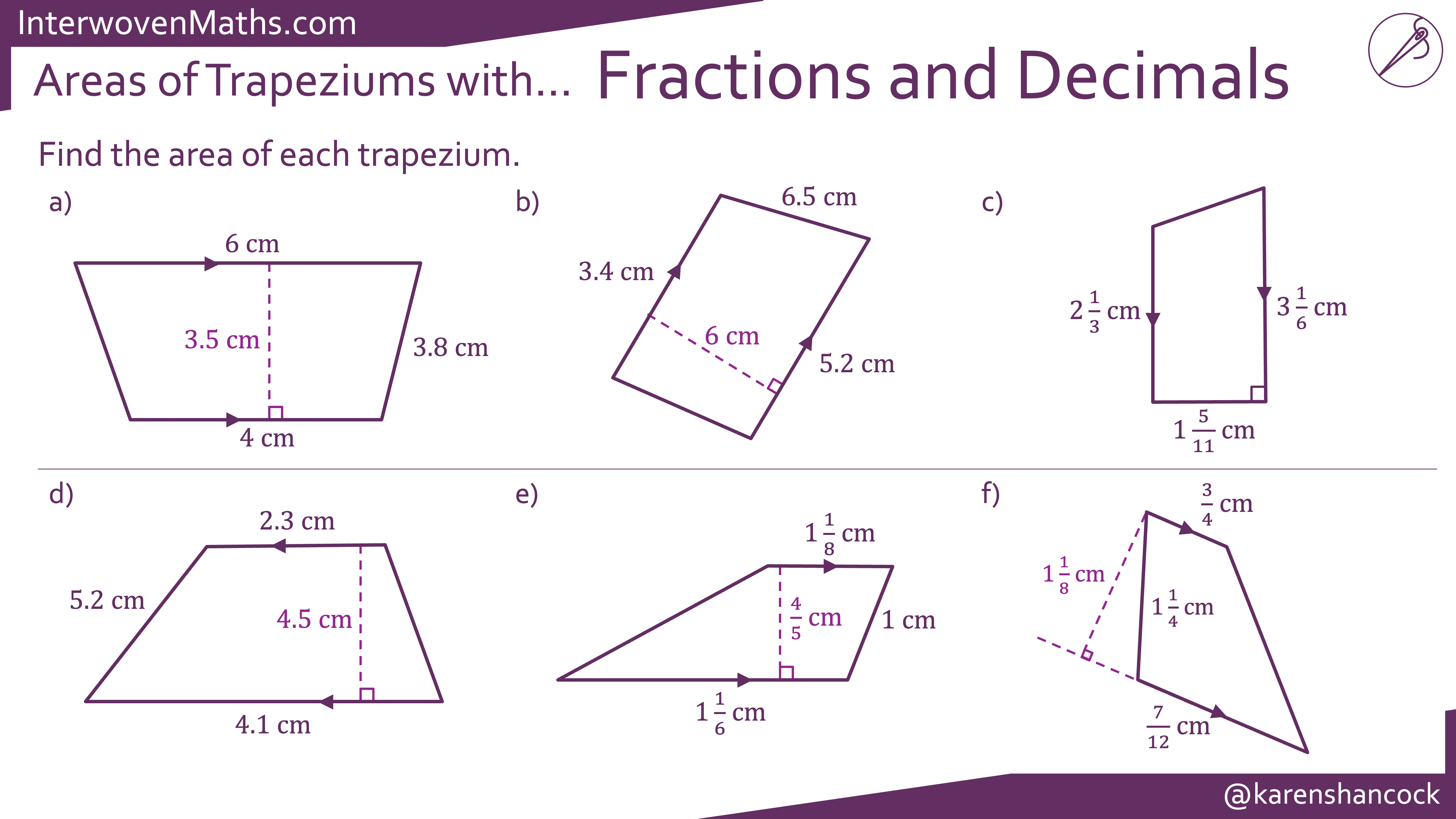 Areas of TrapeziumsArea of trapezium tasks using fractions, decimals, shaded regions, algebraic lengths and missing measurements.
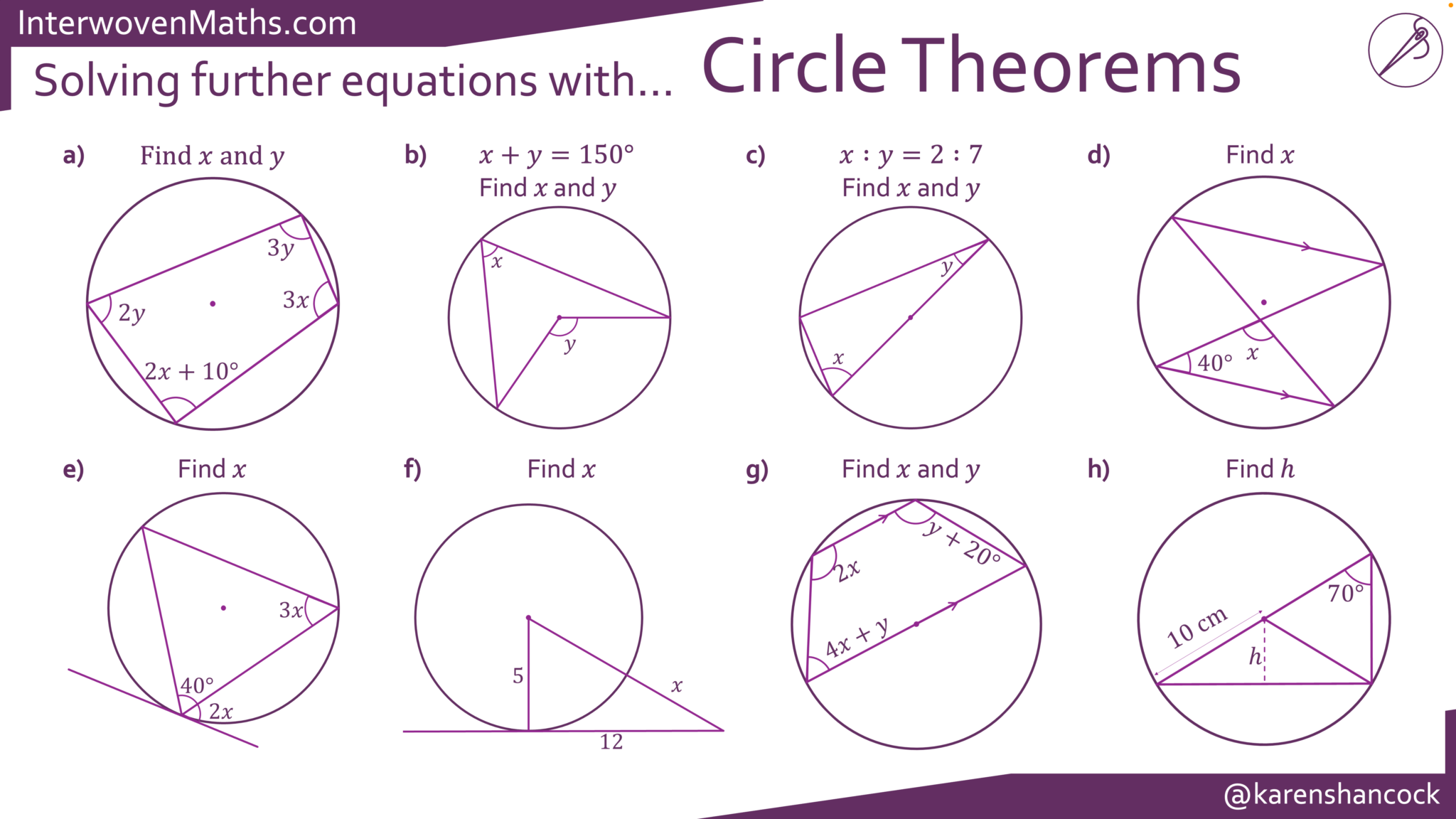 Solving Further Equations from Circle TheoremsCircle theorem angle problems requiring linear and simultaneous equations to find unknown values.
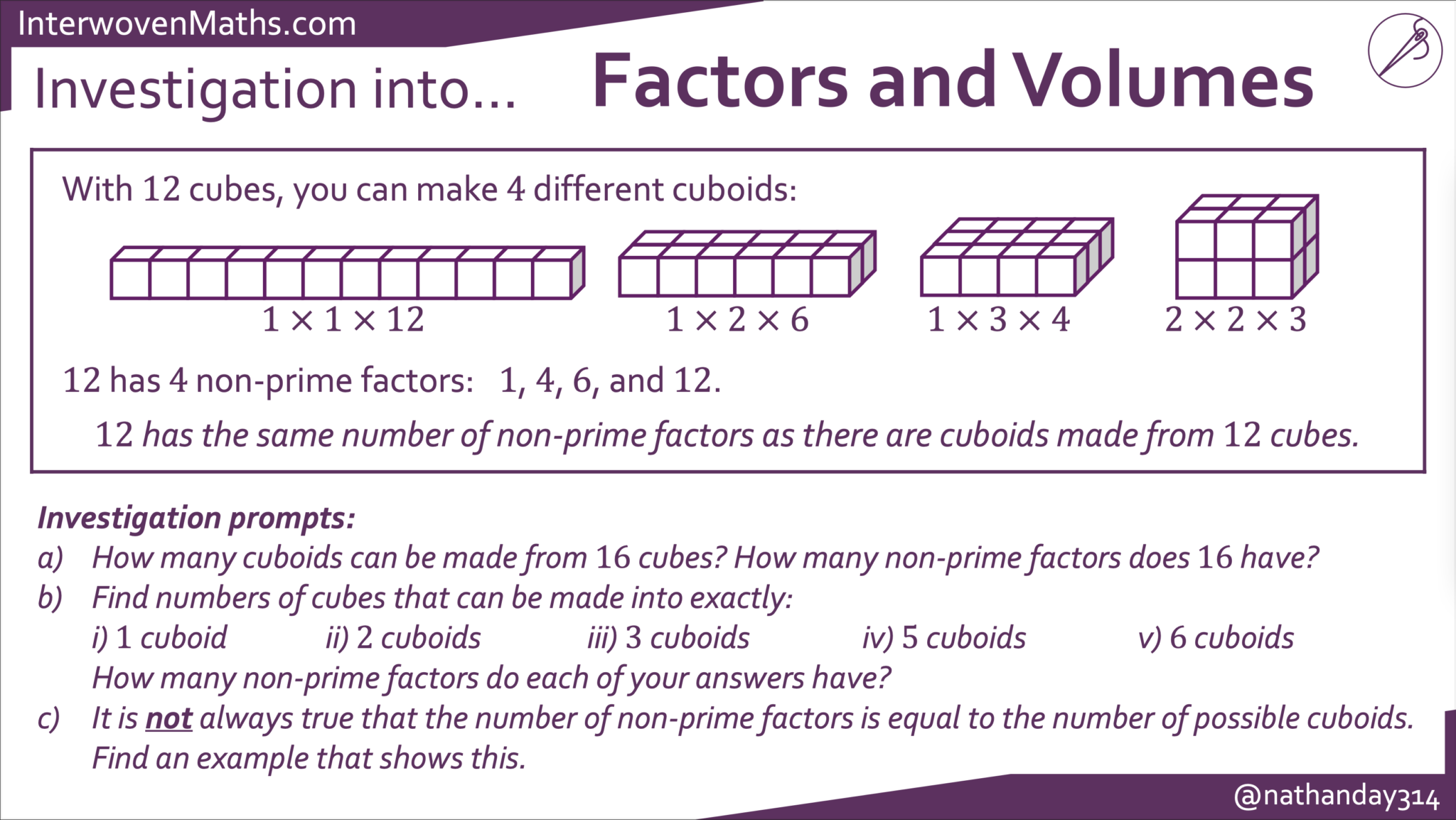 Investigation into Factors and VolumesAn investigation into how many cuboids can be made from a number of cubes, linking factor structure and volume.
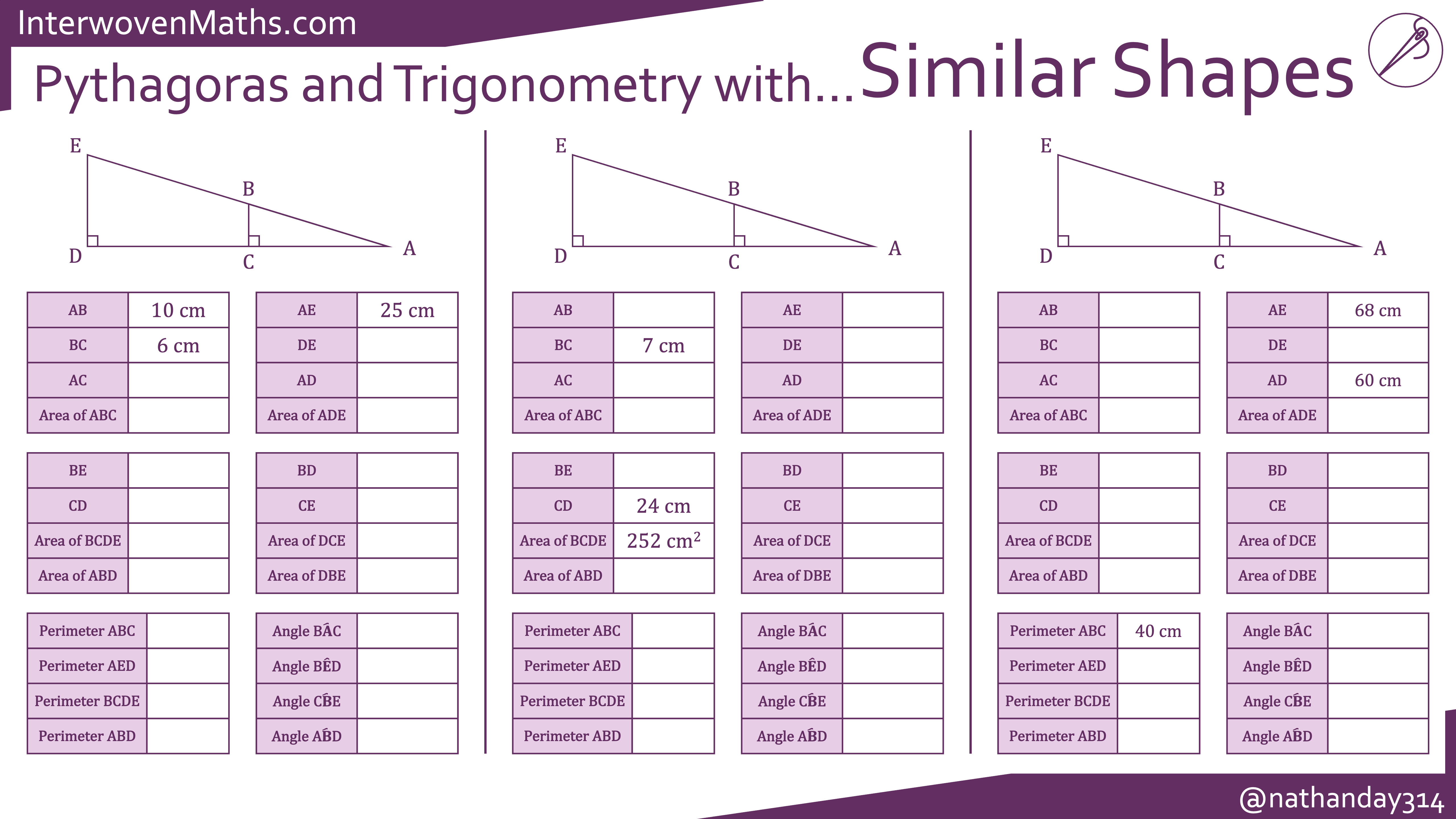 Similar Shapes, Trigonometry, and Pythagoras ProofsSimilarity task linking similar shapes, Pythagoras, trigonometry, area, perimeter and proof-style reasoning.
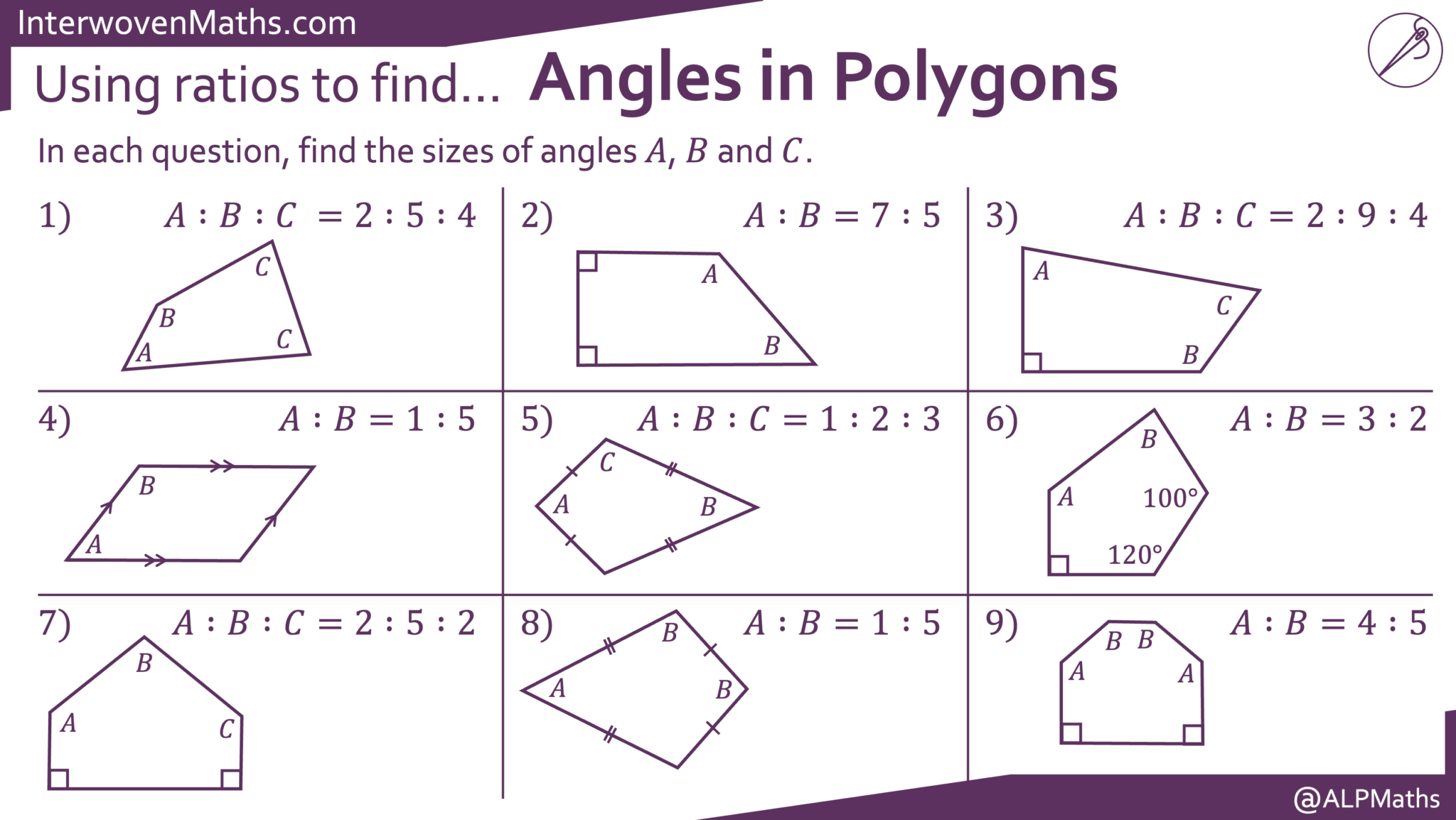 Using Ratios to Find Angles in PolygonsRatio and angle questions for polygons, where students divide angle sums to find missing angles.
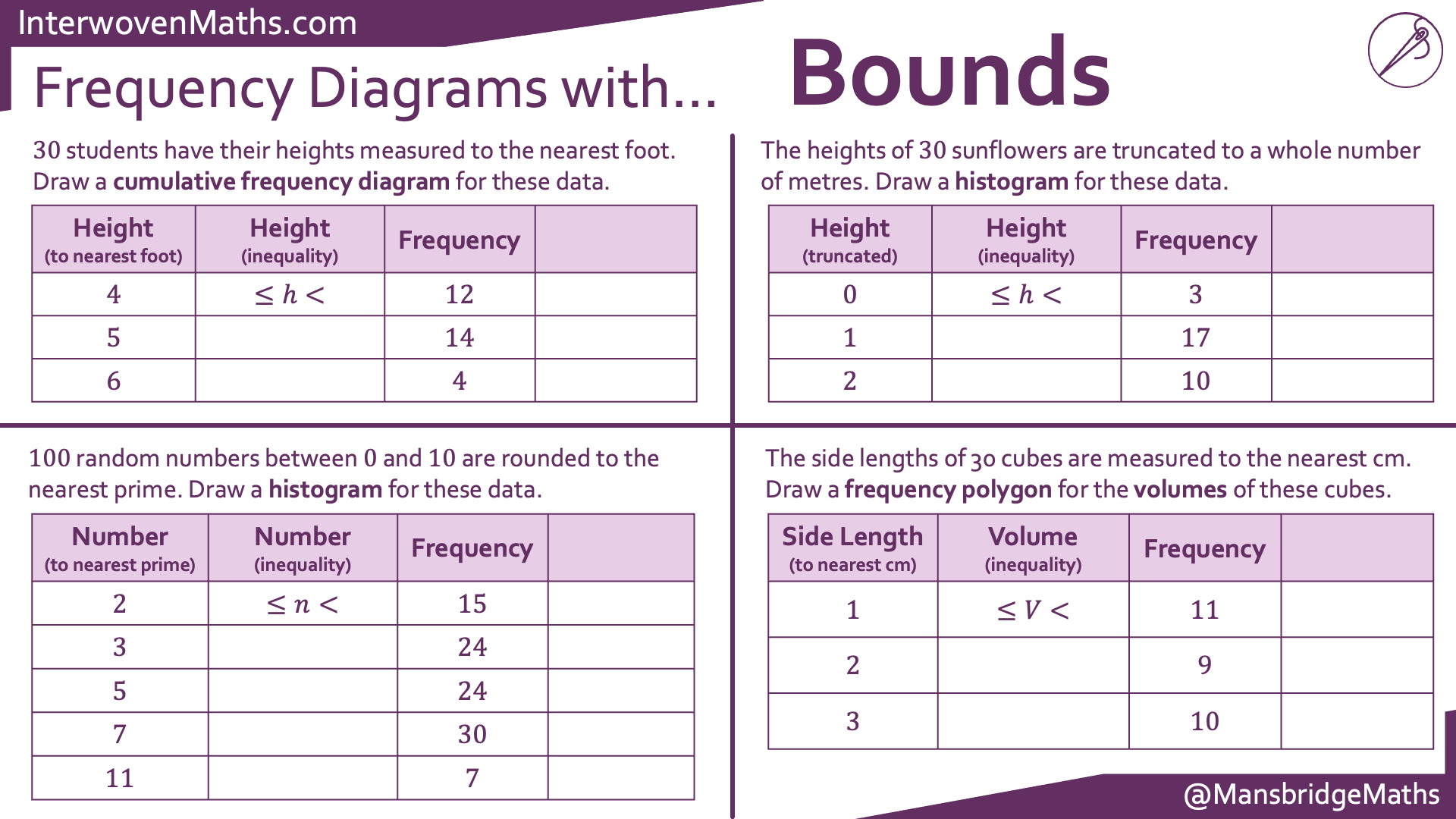 Frequency Diagrams with BoundsBounds and frequency diagram tasks that convert rounded or truncated data into histograms, cumulative frequency diagrams and frequency polygons.
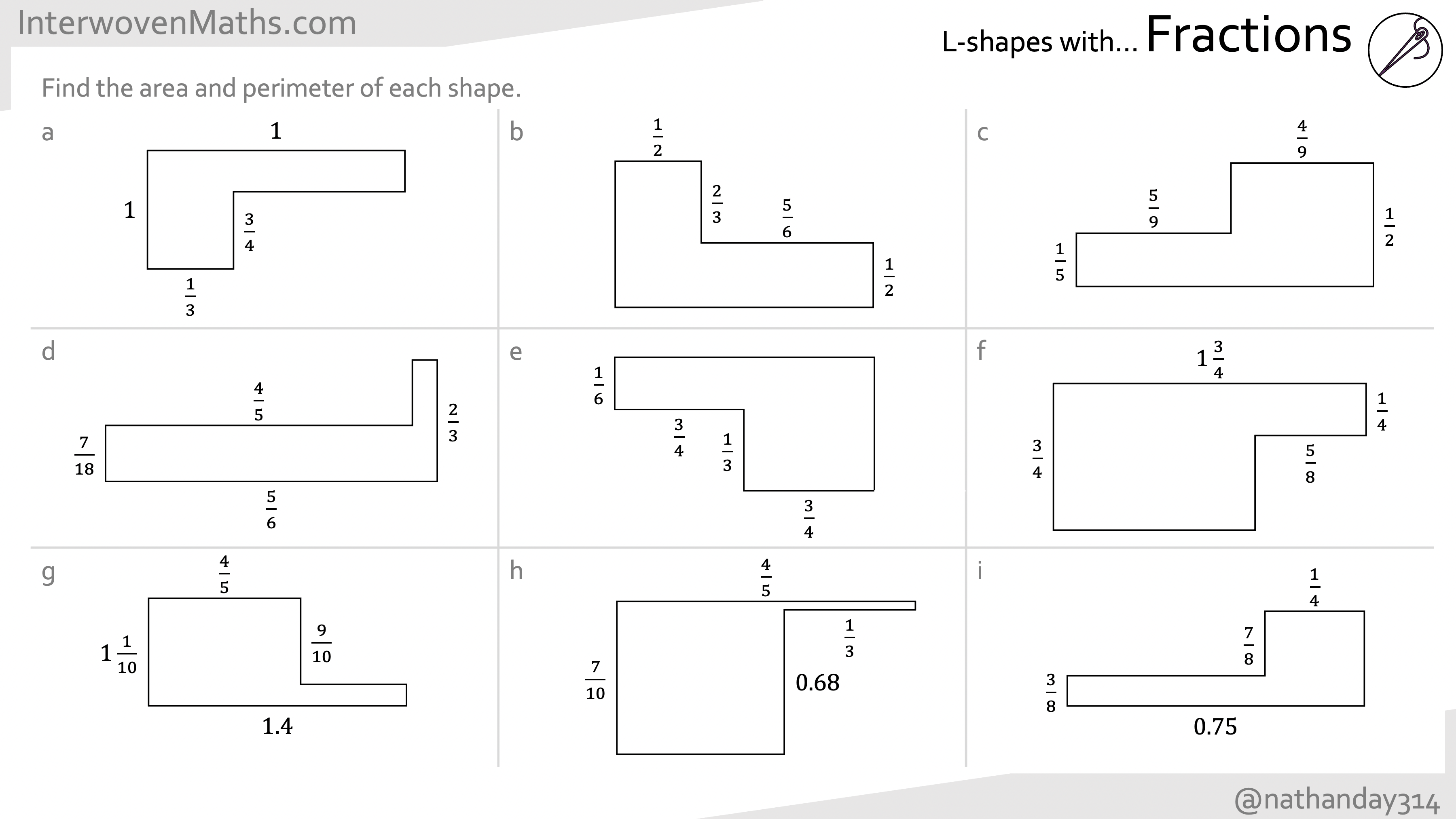 L-shapes with FractionsArea and perimeter questions for compound L-shapes with fractional and decimal side lengths.
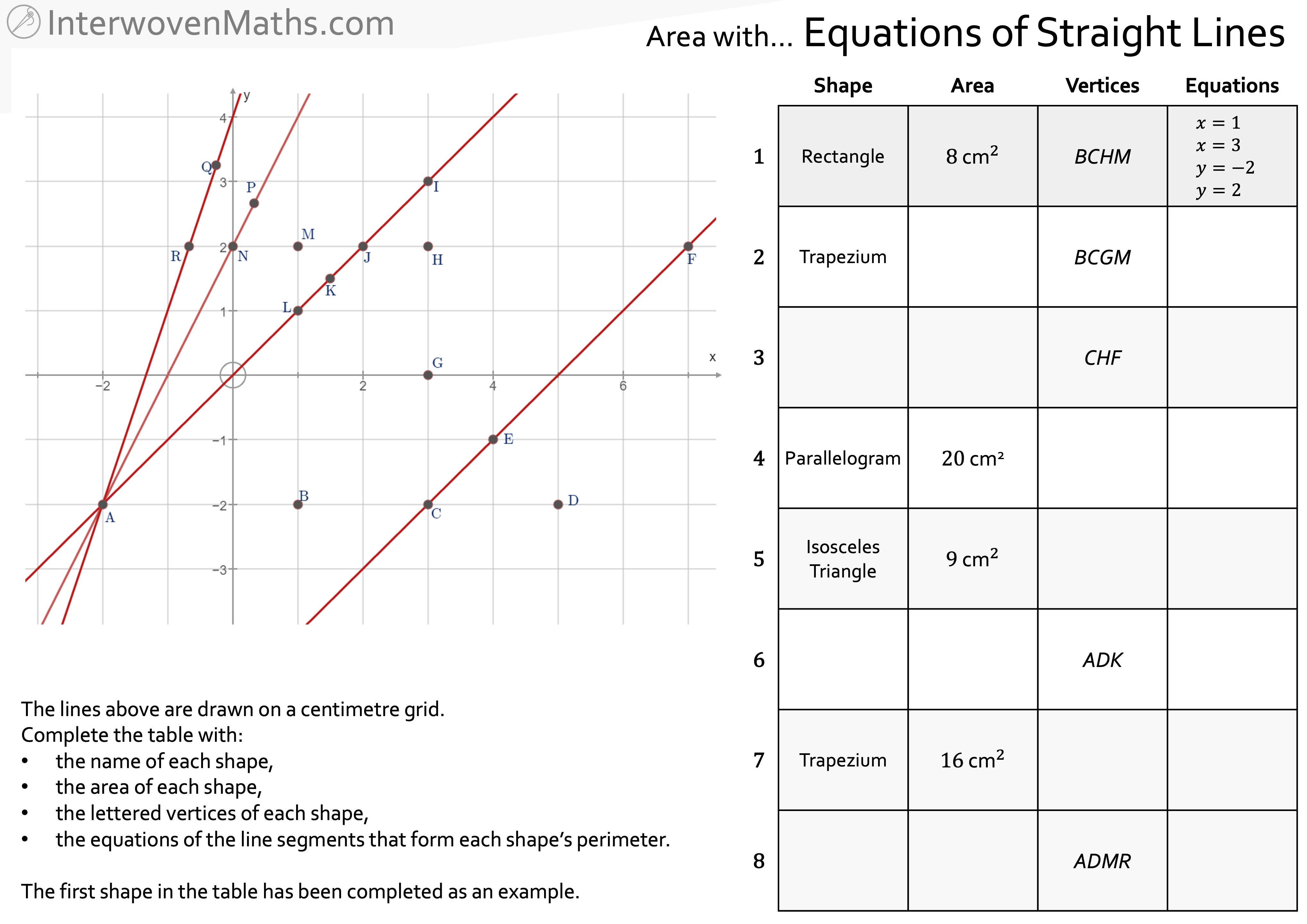 Equations of Straight Lines and AreaA coordinate geometry task linking equations of straight lines with vertices, shape names and areas on a grid.
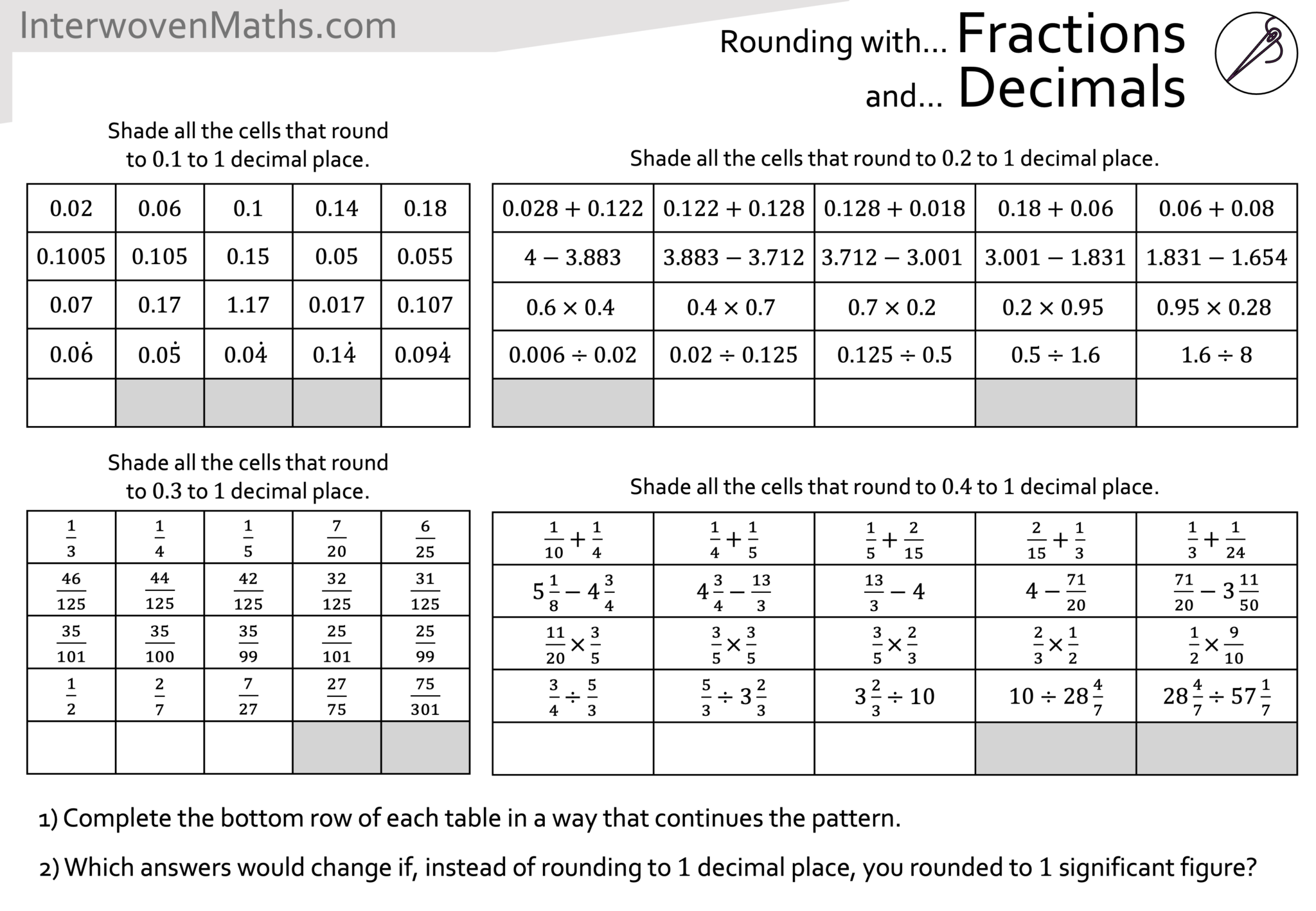 Rounding with...Rounding tasks using decimals, fractions and algebra tables to compare decimal-place and significant-figure decisions.
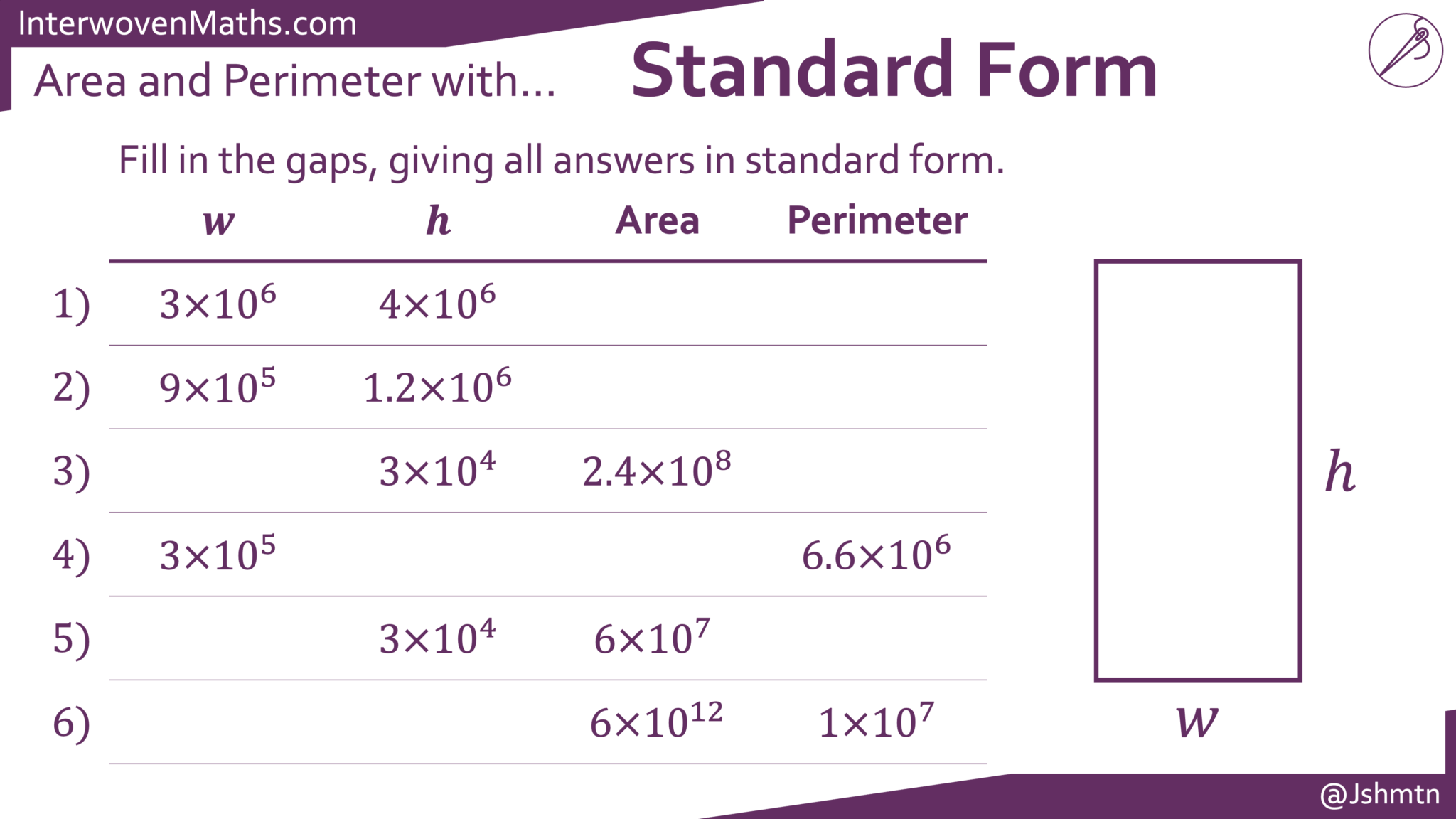 Area and Perimeter with Standard FormStandard form area and perimeter completion tables, including missing dimensions and Pythagoras links.
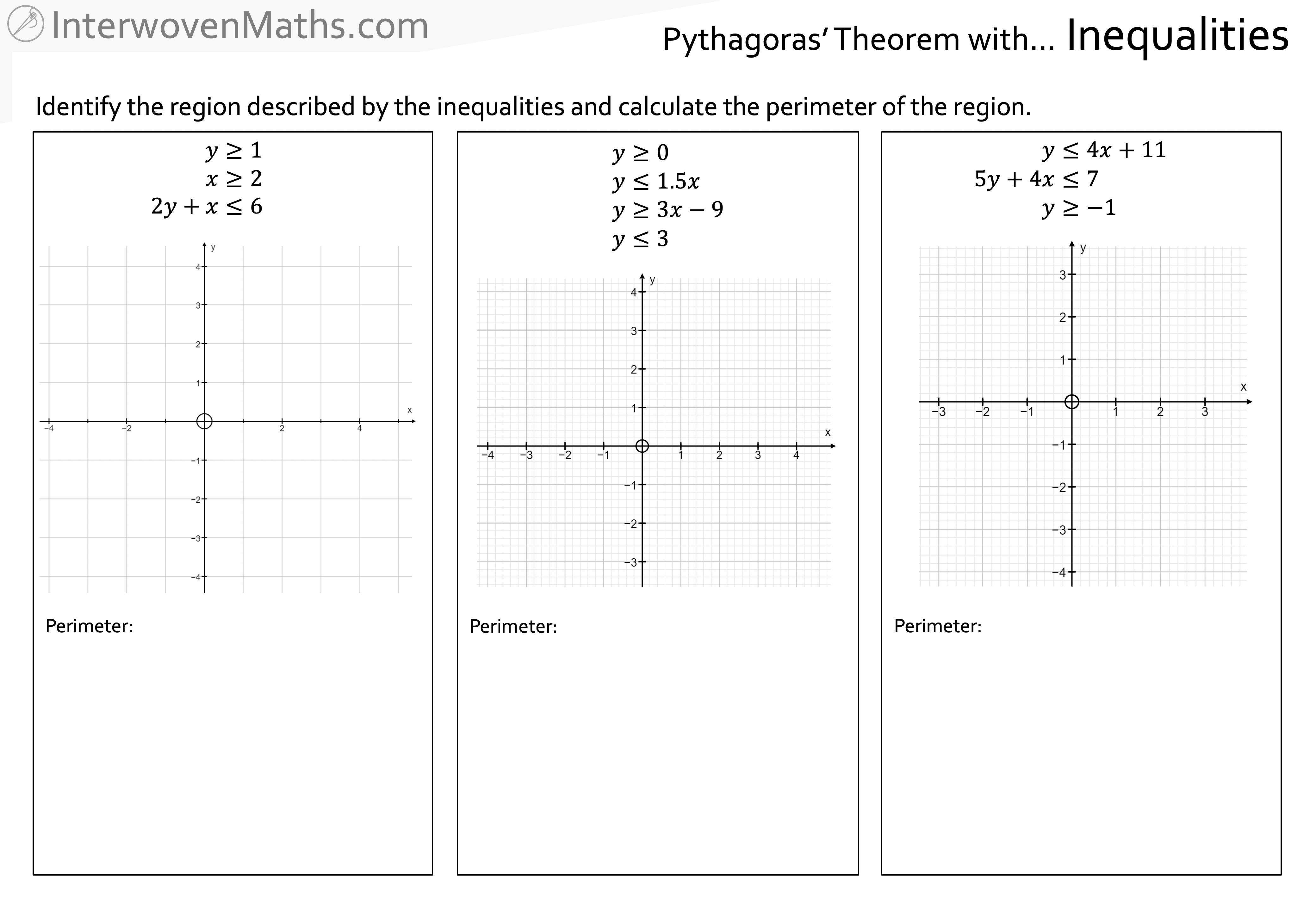 Pythagoras and Inequalities RegionsCoordinate-region task where students identify inequalities and use Pythagoras' theorem to calculate perimeters.
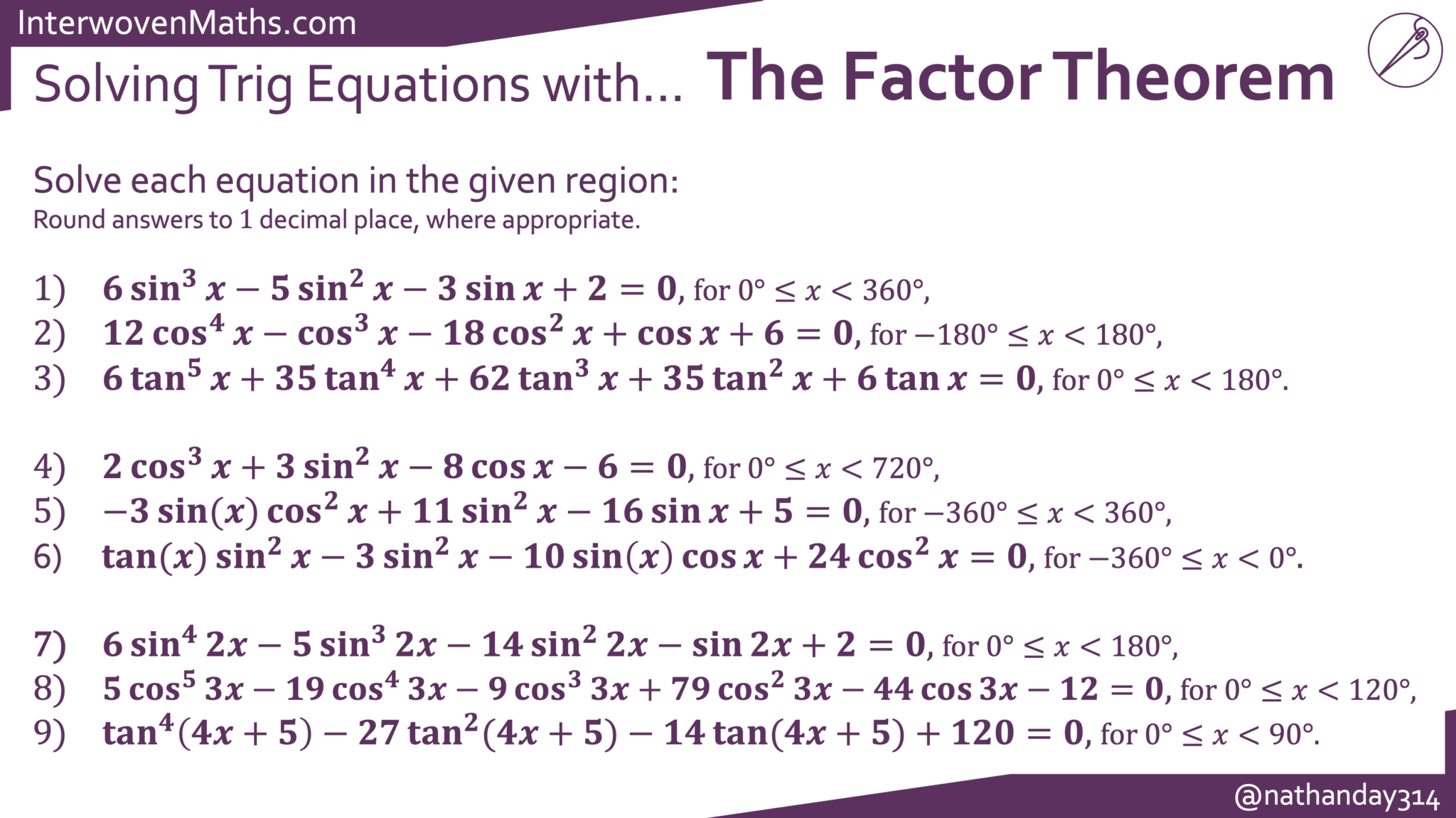 Solving Trigonometric Equations with the Factor TheoremA Level trigonometric equation practice requiring factor theorem style algebra before solving in a given interval.
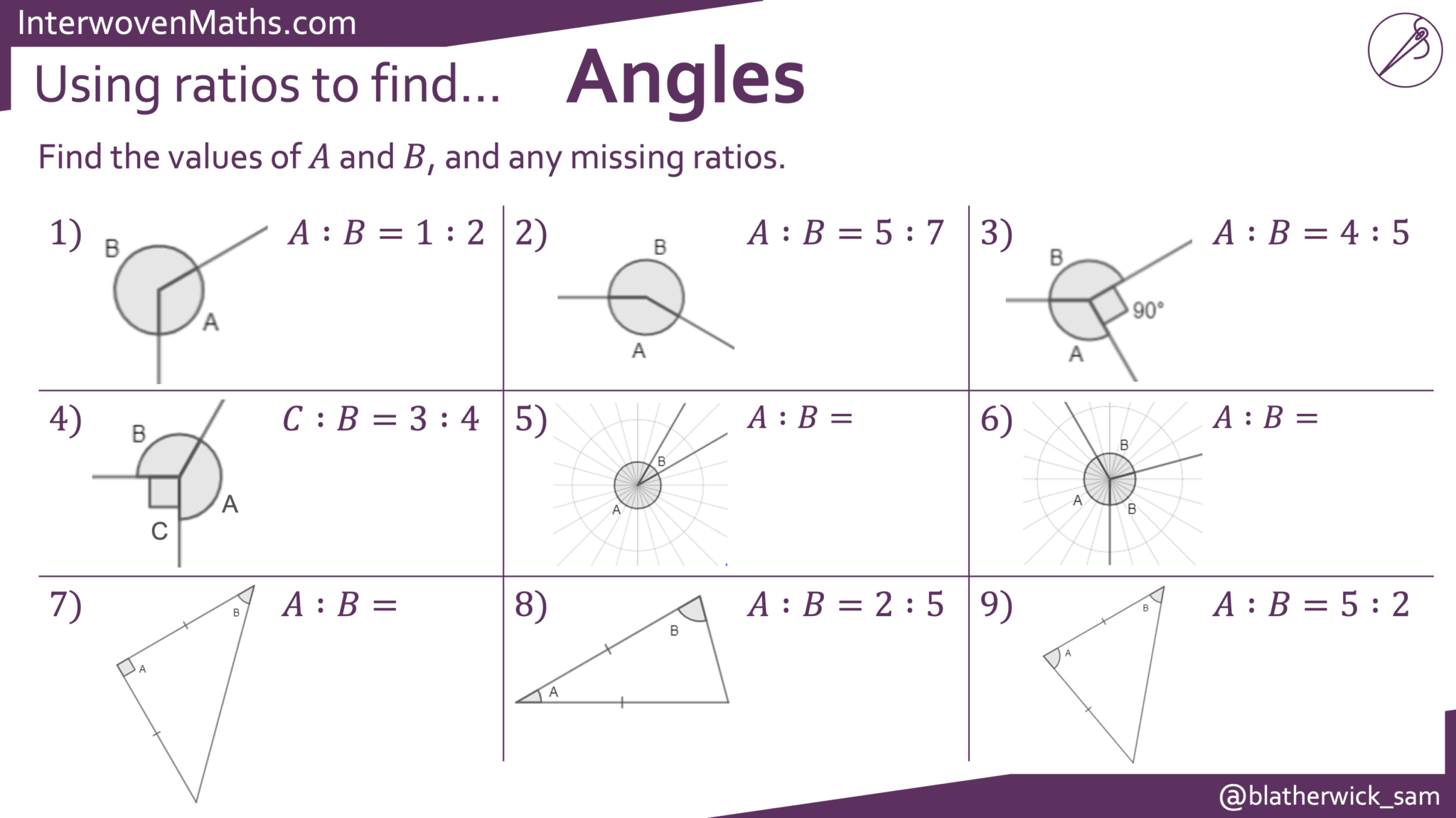 Using Ratios to Find AnglesRatio and angle questions where students divide straight-line, around-a-point and triangle angles.
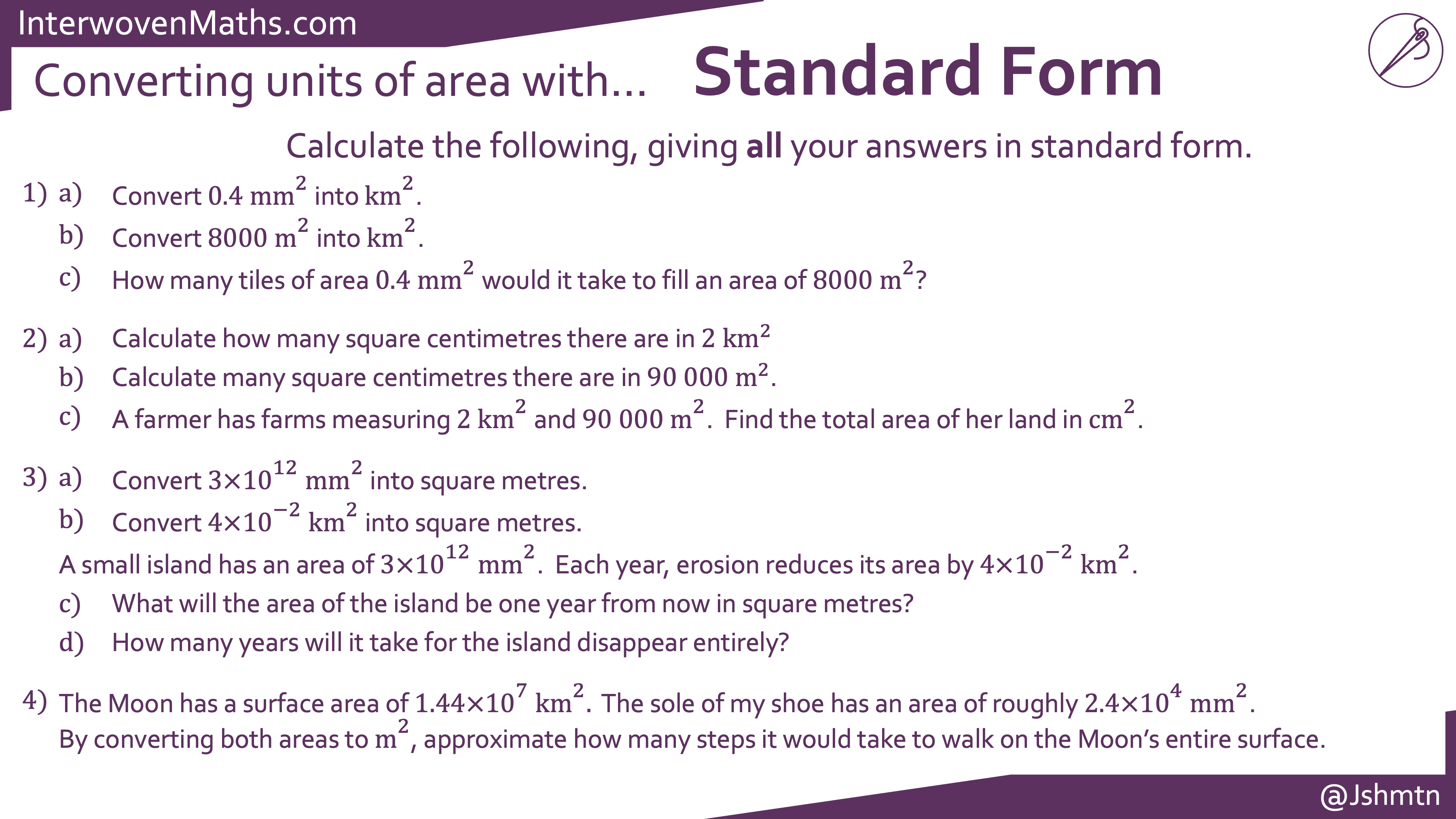 Converting Units of Area with Standard FormStandard form unit-conversion questions for areas, including square units, land area, erosion and scale contexts.
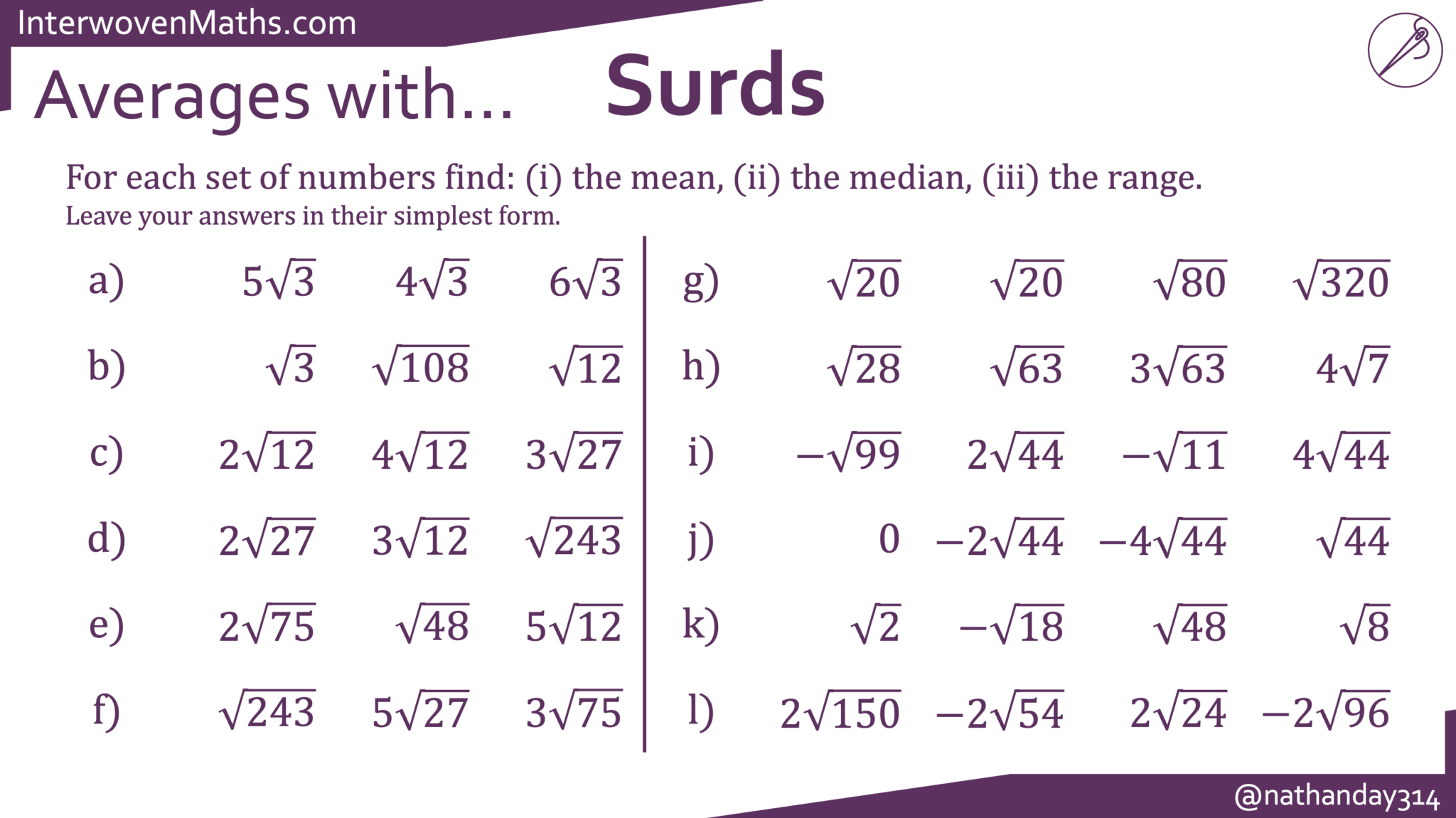 Averages with SurdsAverages practice finding mean, median and range for surd data, with exact simplified answers.
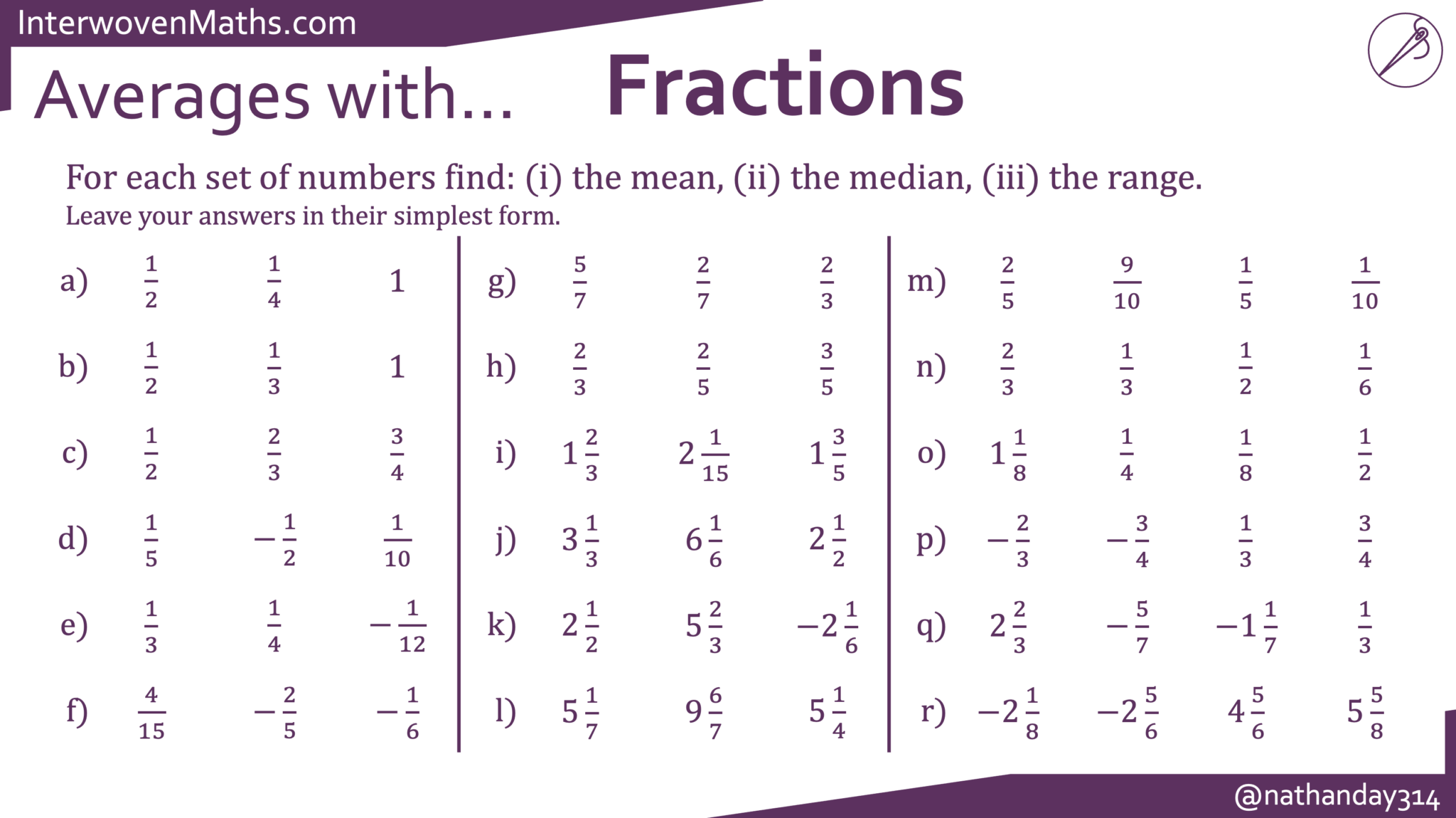 Averages with FractionsAverages practice finding mean, median and range for fractional data, with answers in simplest form.
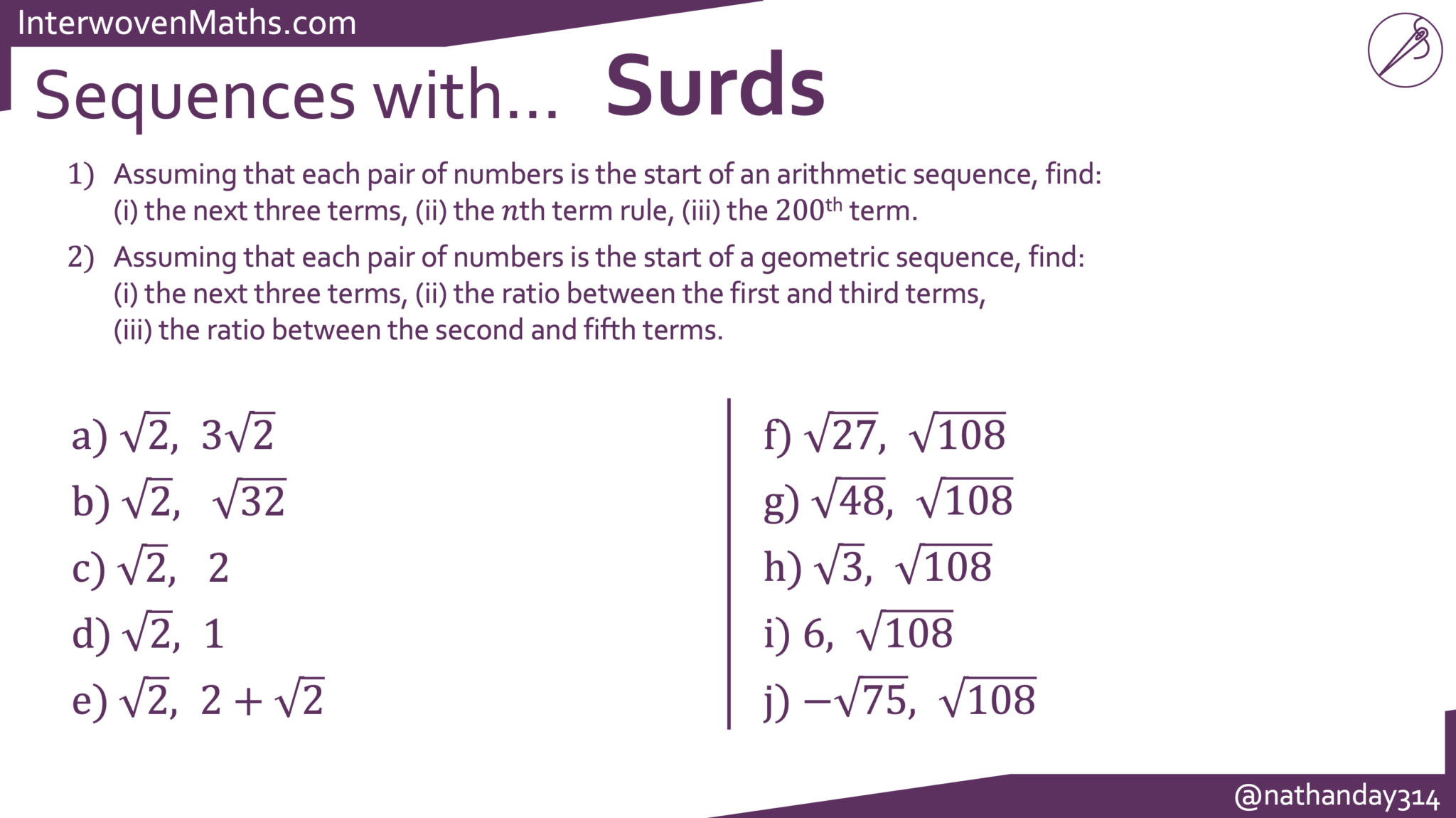 Sequences with SurdsArithmetic and geometric sequence practice with surds, including next terms, nth terms and ratios.
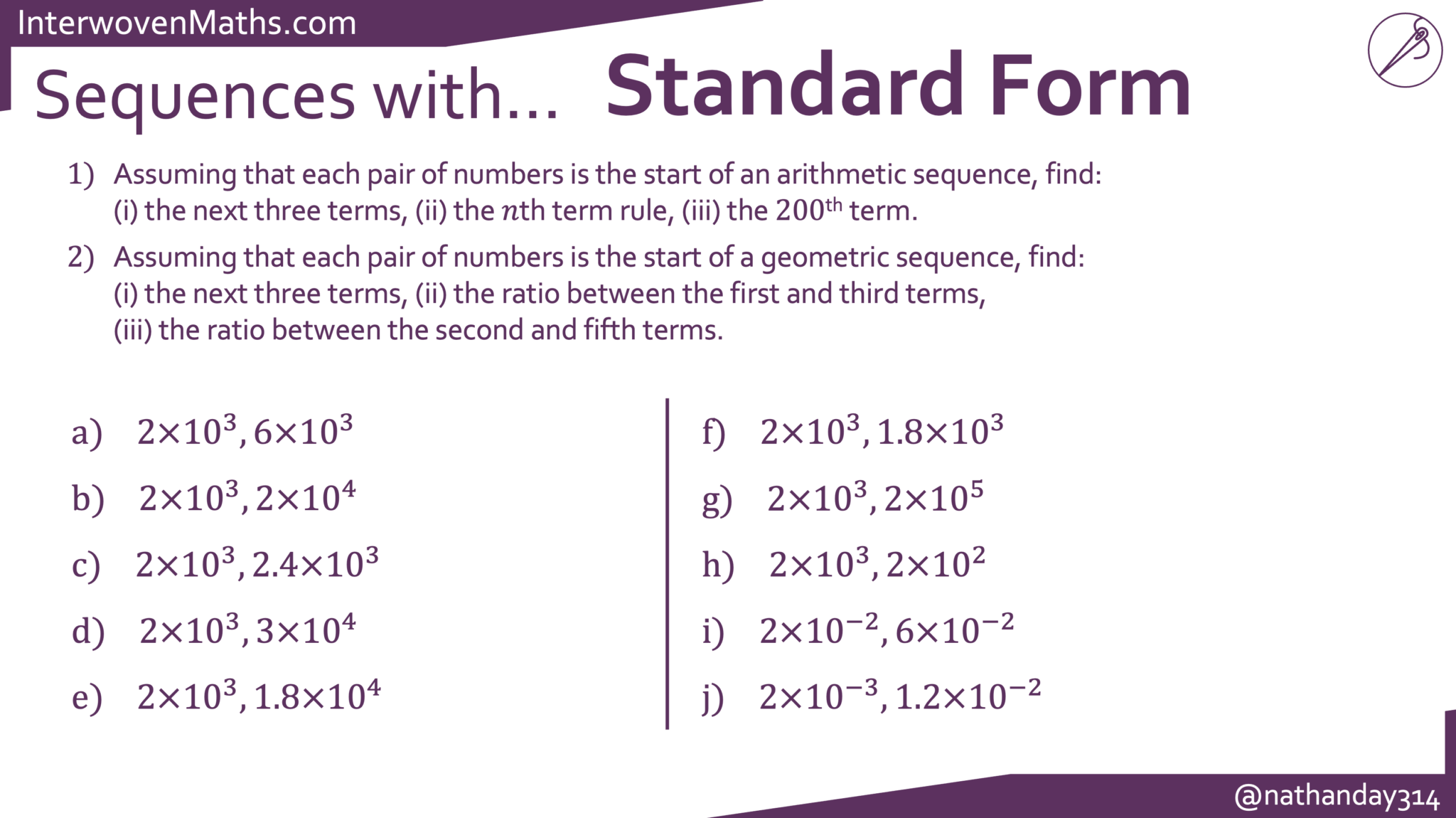 Sequences with Standard FormArithmetic and geometric sequence practice with standard form, including next terms, nth terms and ratios.
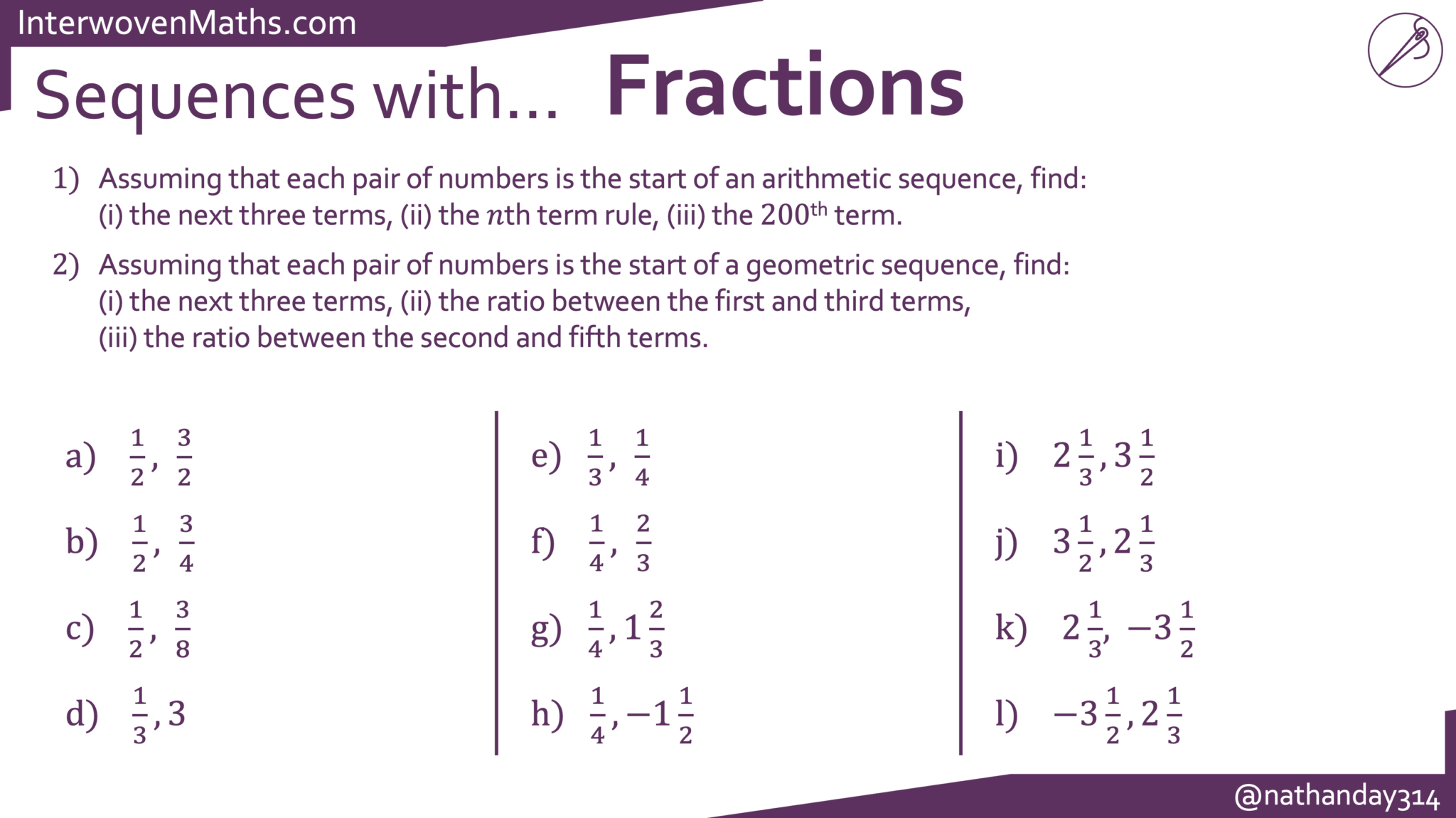 Sequences with FractionsArithmetic and geometric sequence practice with fractions, including next terms, nth terms and ratios.
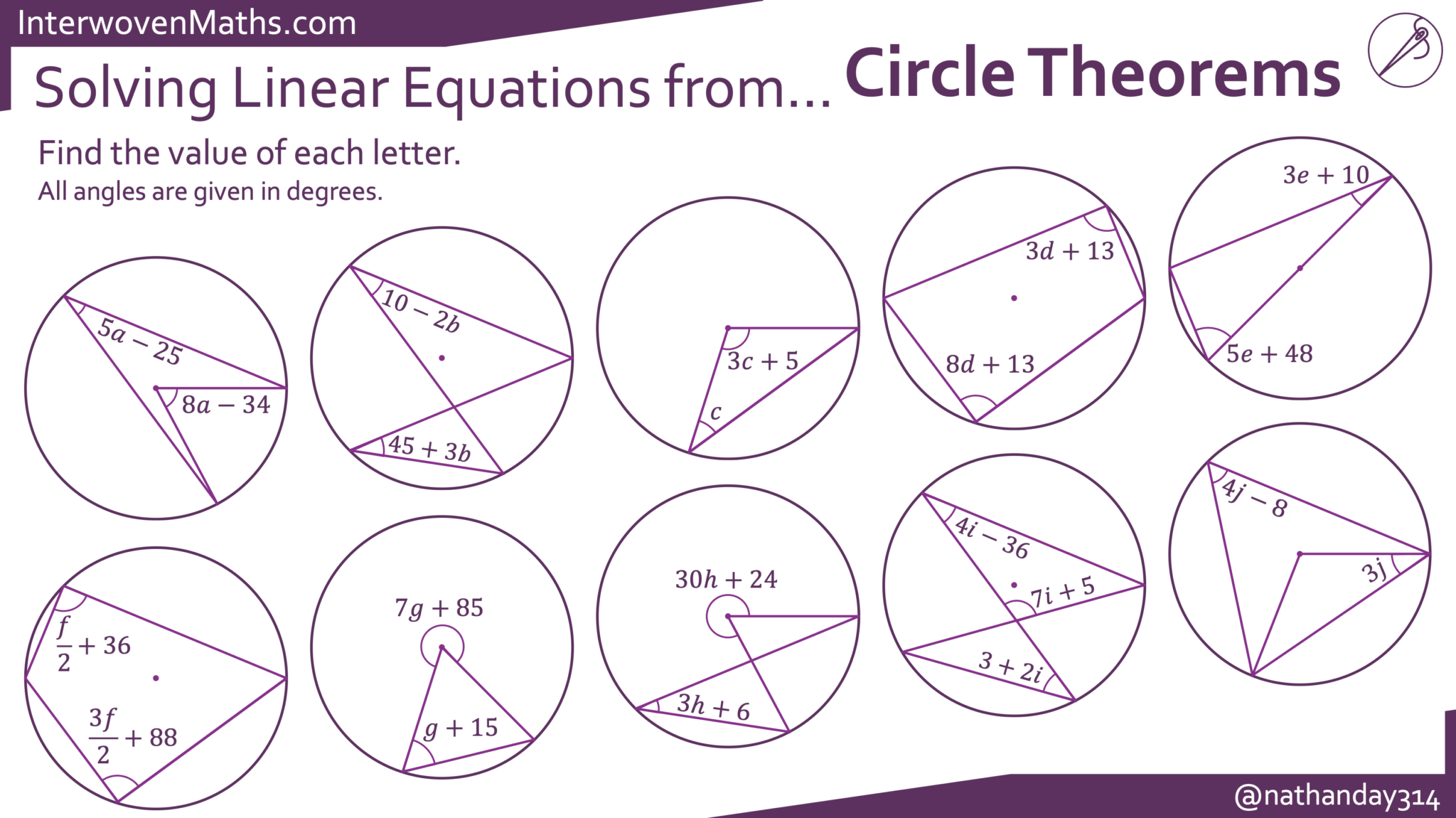 Solving Linear Equations from Circle TheoremsCircle theorem diagrams where missing angles are found by forming and solving linear equations.
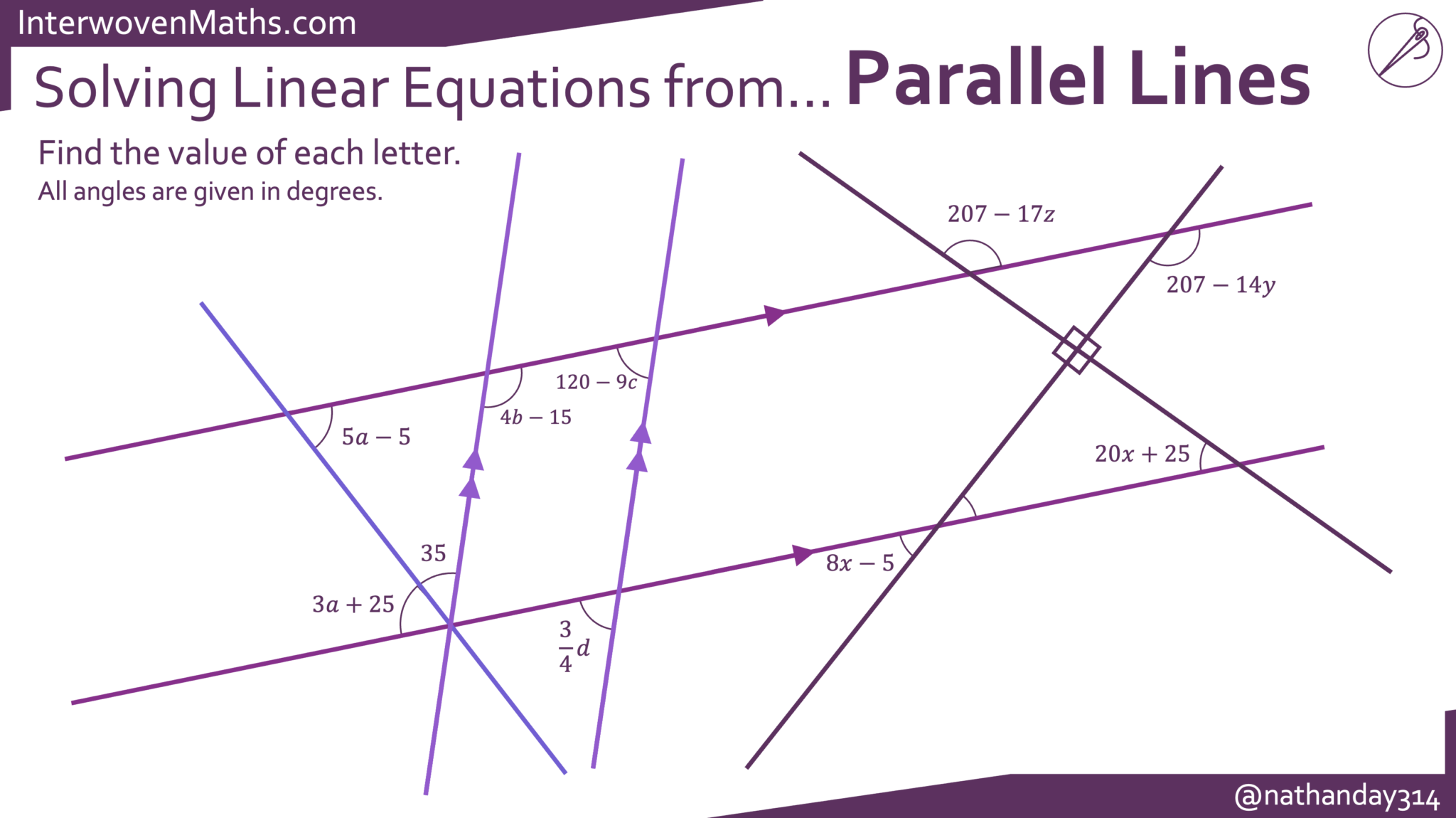 Solving Linear Equations from Parallel LinesParallel line angle diagrams where missing angles are found by forming and solving linear equations.
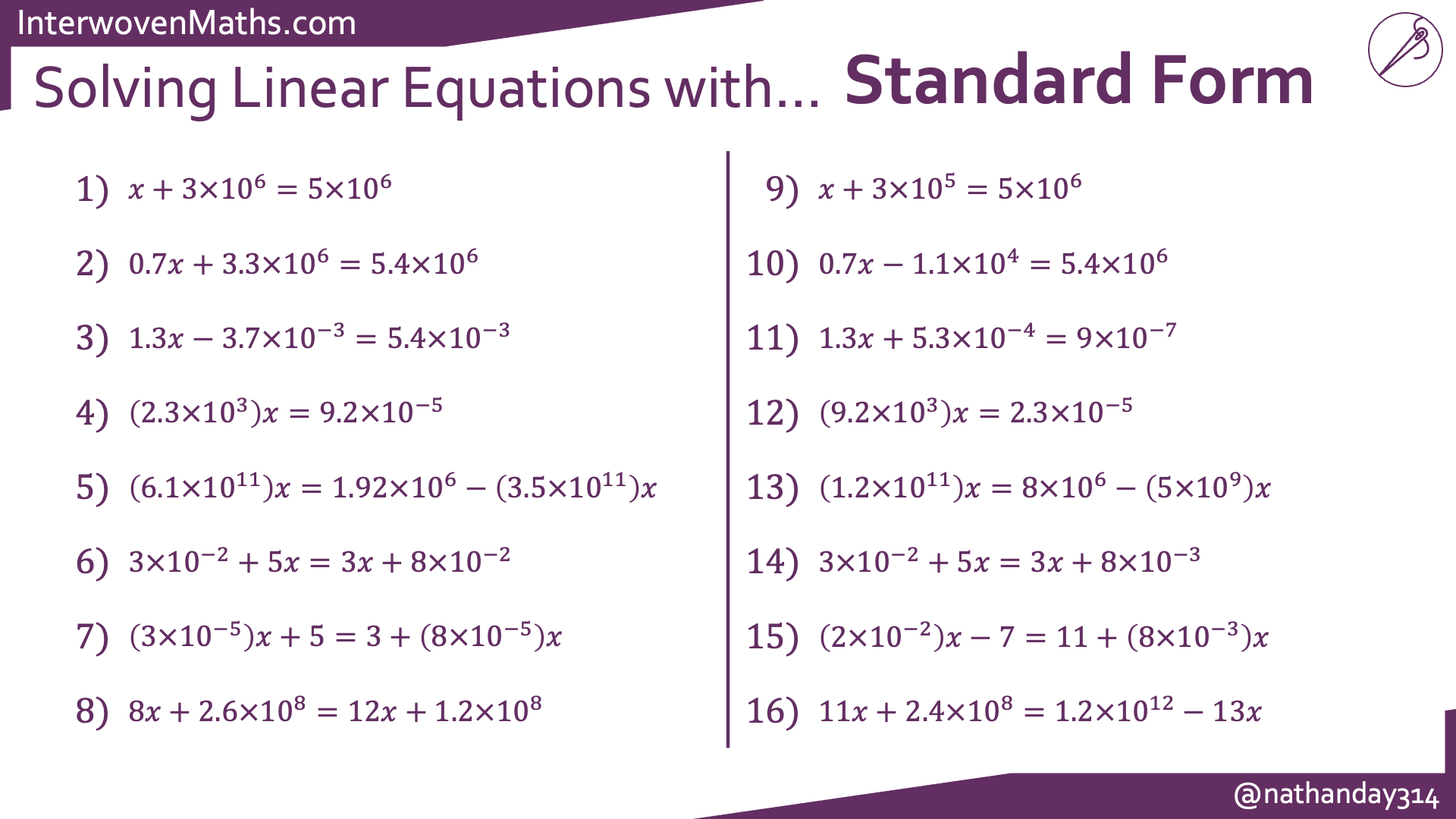 Solving Linear Equations with Standard FormLinear equations practice with standard form coefficients and powers of ten.
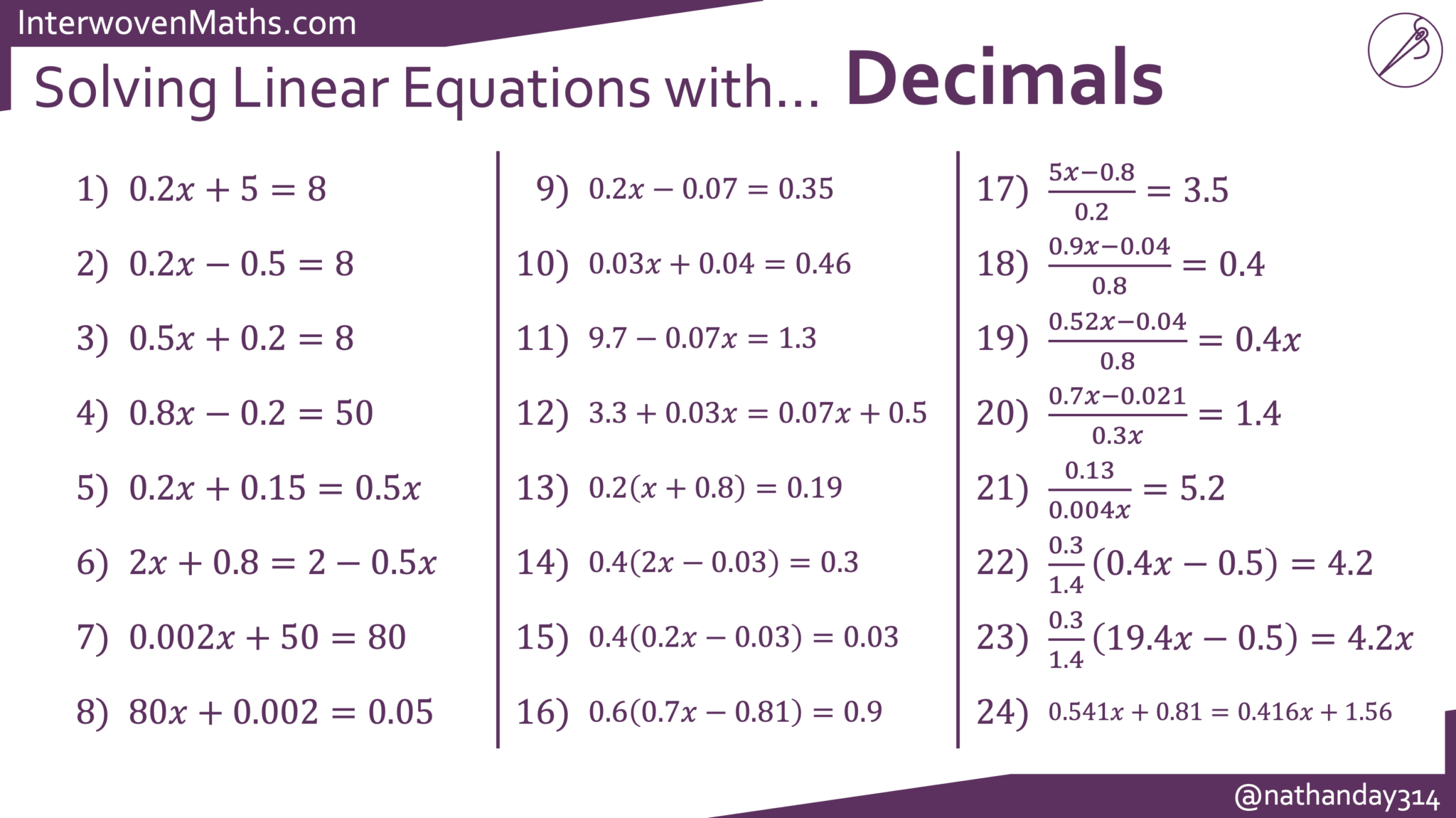 Solving Linear Equations with DecimalsLinear equations practice with decimal coefficients and multi-step rearranging.
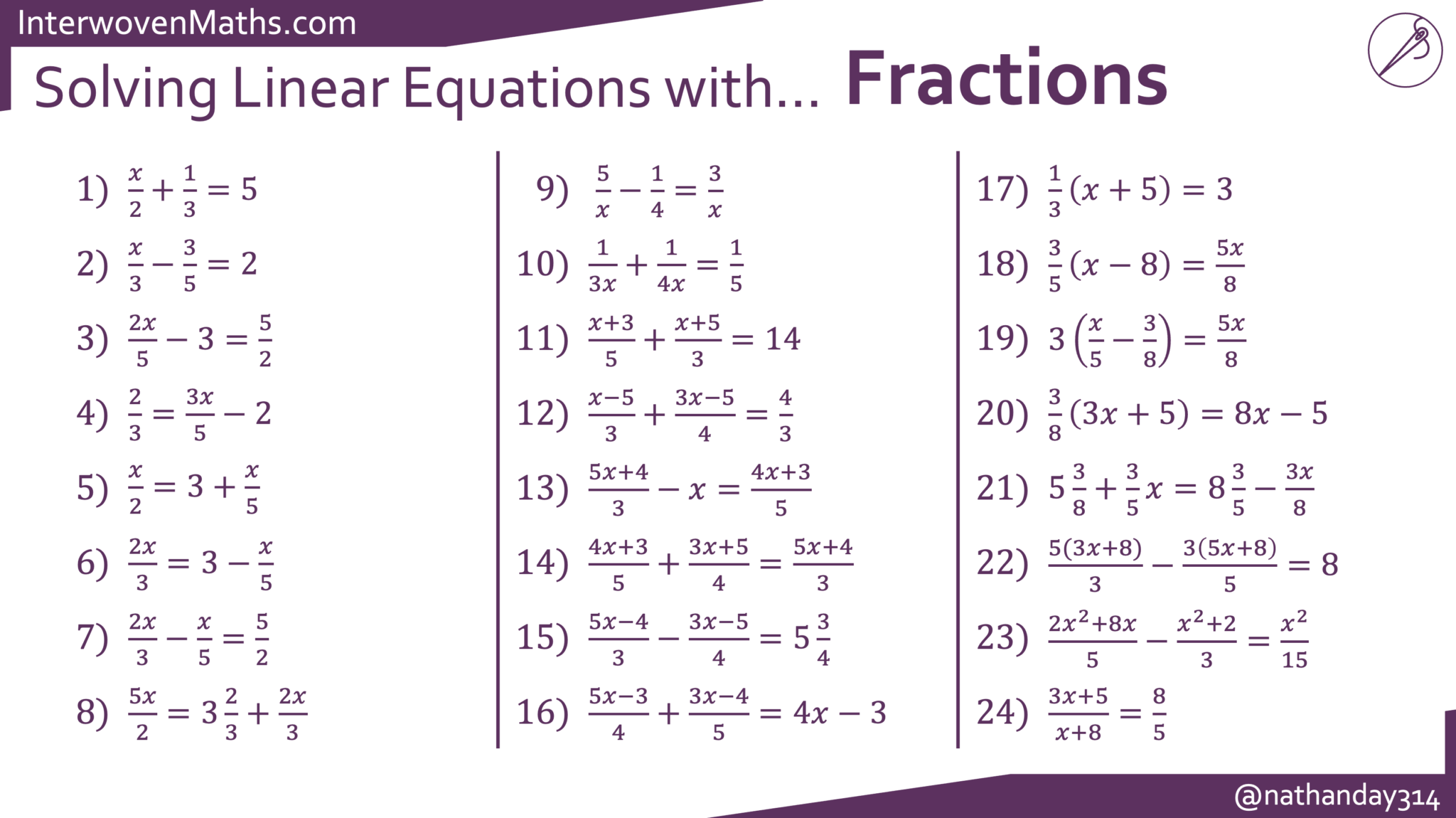 Solving Linear Equations with FractionsLinear equations practice with fractional coefficients, brackets and multi-step rearranging.
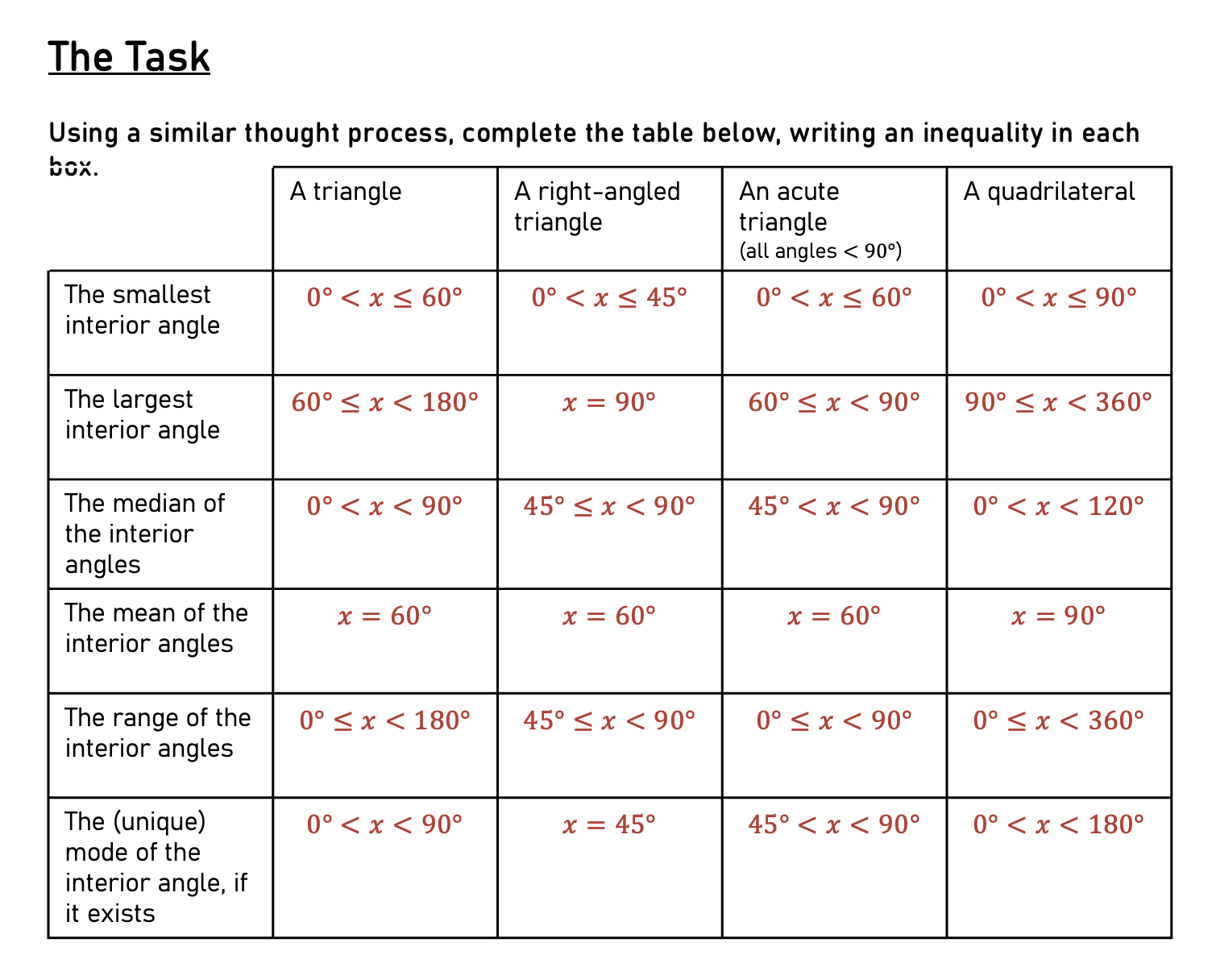 Angles in a Triangle - InequalitiesAn interwoven task on angles in a triangle and inequalities.


